The most spectacular fifteen minutes in Toronto.
I’ve stood in a lot of the world’s celebrated public spaces; plazas in Rome and Lima, riverfronts in Shanghai and London, the manicured squares of Kuala Lumpur, a boardwalk in Dallas that tries oh so hard to be a true boardwalk. But none of them do what the Toronto Islands do, because none of them make you leave first.
Urbanists are supposed to hate barriers. We spend an enormous amount of time thinking about how to make cities more connected, more walkable, more legible, and of course more accessible. So when we see a giant park sitting directly offshore from downtown Toronto, it is almost irresistible to draw a line across the water and ask:
Why haven’t we connected this yet?
But I think that question gets something fundamental wrong. The ferry isn’t an obstacle between Toronto and the Islands. They are an experience of leaving the city behind. And that distinction matters. Let’s compare some other examples.
Central Park is extraordinary, but you’re never quite allowed to forget that you’re in Manhattan. The city presses in on all four sides: the skyline is always there, the avenues regularly interrupt the landscape, and you can leave almost as quickly as you entered. Mont Royal offers Montréal a deeper sense of escape, with forested paths and sprawling slopes that seem to lift you above the city, but eventually you descend and find yourself back in it. San Francisco’s piers and waterfront promenades offer another version of the same idea, a beautiful edge to a beautiful city, but still an edge of the city. These places are great precisely because they are urban parks: their magic comes from their relationship with the city around them.
The Toronto Islands work differently. They are not simply a park within Toronto; they are a place you have to leave Toronto to reach. The journey is not an inconvenience before the experience begins, the journey is the beginning of the experience. The water is the threshold, and crossing it creates the separation that makes the escape feel real.
There is something distinctly Canadian about that: a relationship with waterways as routes into another landscape, where getting there means leaving the hard edges of the city behind and moving, quite literally, into nature. It recalls the tradition the Group of Seven so famously captured—the idea that wilderness is not simply something to look at from the city, but somewhere you go, across lakes and rivers, into a landscape that changes your sense of where you are. The Islands offer a remarkably urban version of that same impulse, only minutes from downtown.
However Toronto’s geographical gift is one that we seem increasingly determined to optimize away. You leave one of the densest, most vertical cities in the world, walk toward the stunning waterfront, and with a few taps, and a queue that most definitely could work better, you are on a boat. Not a beautifully landscaped promenade. Not a steep hill to hike. Not a busy inner city intersection. A boat.
The best part of the Island is before you get there
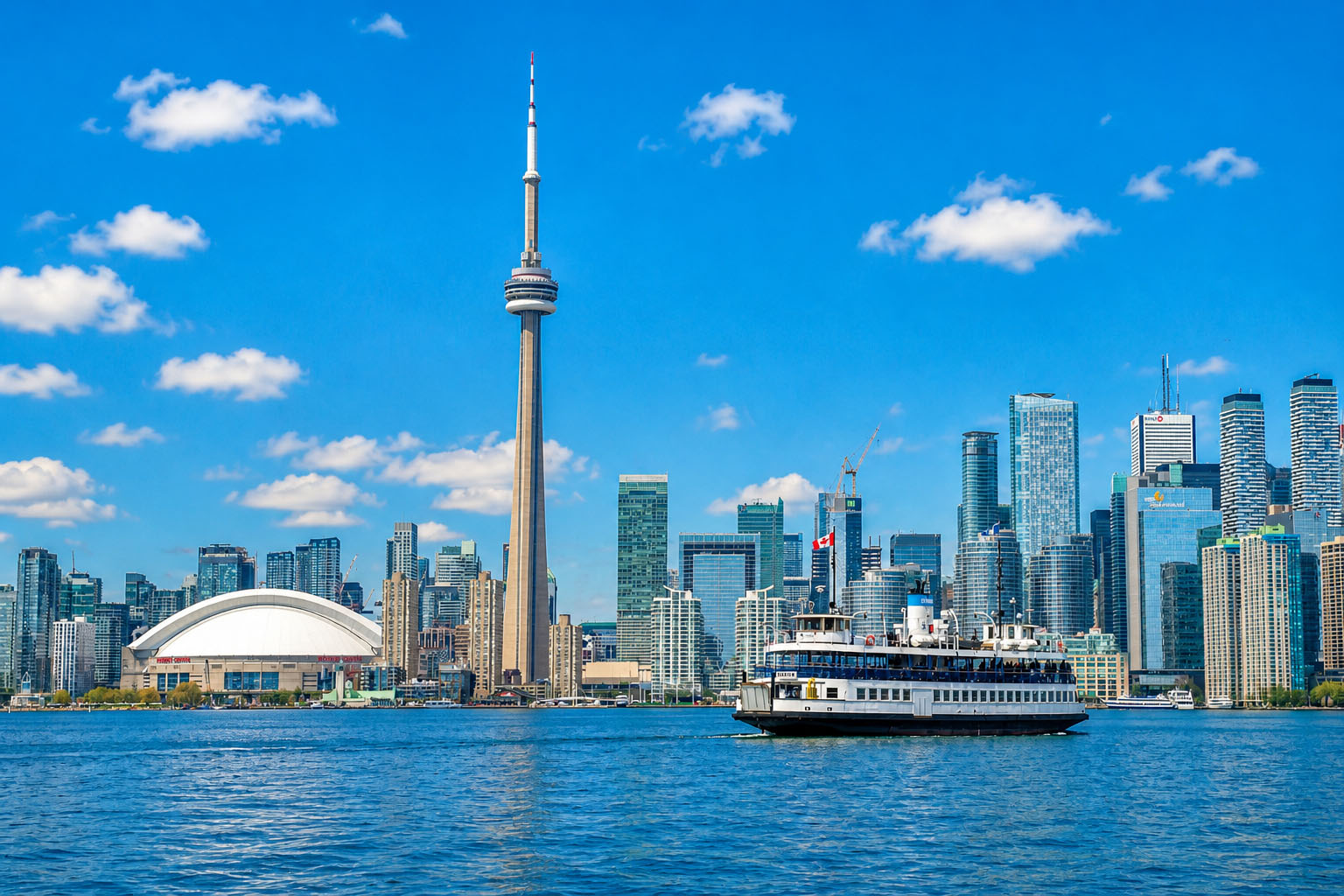
As you pull out onto the Harbour, the walk through Jack Layton Terminal from streets still loud with cars and glass towers fades quickly from thought and the glass towers that felt enormous from Bay Street becomes a gallery of modern architecture. The CN Tower rises above them. An open Skydome signals the Jays are playing.
The harbour performs for you on the way over: sailors crossing tacks, kayakers ducking under the flight path of planes landing at Billy Bishop. Harbour ferries move between routes. Cargo ships occupy an entirely different scale, while jet skis zip around, paddleboarders waddling the shores, a pirate ship full of tourists, and without fail, someone is piloting some strange homemade-looking watercraft that you have never seen before.
And then, somewhere in all of that, you notice the birds. Swans dating. Kingfishers. Canadian Geese with their spring babies.
The experience is cinematic…
It is an incredibly rare urban experience. As anyone who follows my channel know, I’ve travelled all over the world and countless other cities have their own great parks, grand plazas and civic spaces that make you question — how did they afford that. So many are magnificent. Truly. But very few give you escapism the Islands gift us.
I didn’t plan to write about the Islands. Then Toronto Twitter happened. Toronto Twitter did what Toronto Twitter does: it found a part of the city it loves and decided that love wasn’t enough, that what the Islands really need is infrastructure.
I won’t spend long on why a subway, gondola, or even bridge idea doesn’t survive contact with reality, but it’s worth saying once. An eastern crossing has to clear the Eastern Gap, which is still an active shipping channel, any bridge high enough for the ships that use it would be a ramp, not a walk. A western crossing runs straight into Billy Bishop Airport’s approach and the harbour’s own aviation clearances, as well as the western channel that affords access to most of the harbours recreational water sports and sailing. And even in the fantasy where either got built, you’d land people at the far edges of an archipelago whose best-loved grounds, Centre Island and Hanlan’s, sits as their name suggest, in the centre, reachable by an over 6km hike across the islands.
But I don’t want to spend this post refuting a underwater subway or sky-scraping pedestrian bridge. I want to spend it explaining why the debate missed the point entirely, because the thing that makes the Islands the best public space in this city isn’t a flaw to be engineered away. It’s the whole reason the place worked in the first place.
Distance Was Never the Metric
If speed and directness were what made a park good, High Park would be unbeatable. A dedicated streetcar loop and two subway stations feed directly into it. It also connects to major roads and has ample parking. Trinity Bellwoods has two streetcar lines and a bus close enough to count as a third, plus a pretty sweet view of the CN Tower peaking above the lawn. The cities new Biidaasige Park is a ecological masterclass in urban park design. Walkable paths meander waterways, sculptural parks and gathering zones, its transit-adjacent, and of course gives you an uninterrupted skyline view all without getting on a boat.
All three are wonderful parks, each serving different needs. However, none of them feel like the Islands, and the difference isn’t acreage or programming, the Beaches has more sand, High Park has more forest, the Distillery District has more heritage walk ways than the Islands’ classical gardens and avenue ever will. The difference is that those parks are stitched into the city’s fabric, and the Islands are deliberately, geographically not.
Push a little deeper into why visiting the islands feels more special than other parks and there’s a second, quieter reason the Islands inspire the kind of fierce, borderline territorial love that produced this week’s backlash to the backlash: almost nobody uses “the Islands” the same way.
You can spend the day there without buying much of anything. Bring a towel and swim. Bring a bike and wander until you have forgotten your way is back. Bring a frisbee, plan a picnic with your entire family, or come alone with a sketchbook, a fishing rod, whatever you like really. Find a patch of grass and lie down. Find a beach. Find another beach. Or don’t do anything at all.
From one part of the Islands to the next runs an ongoing history of how Torontonians have balanced dense city living with the desire to retreat into nature. Hanlan’s has offered queer Torontonians refuge for generations; Centre Island’s formal gardens and promenades evoke something closer to a European pleasure ground; and Ward’s Island is essentially a cottage village that happens to sit a twenty-minute boat ride from the Financial District. There is a children’s garden, a campground that looks more at home in Algonquin Park than downtown Toronto, and countless smaller pockets where different communities have made the Islands their own.
And then there are the things that don’t show up particularly well on a municipal list of amenities: teenagers stretched across a blanket with a speaker and nowhere else they need to be; families unloading coolers and picnic baskets for the afternoon; newcomers to Canada taking photos of the skyline; first time cyclists weaving between the paths; someone fishing quietly from the shore; swimmers in both burka’s or bikini’s heading into the lake; grandparents watching children run through the grass; a dog tearing around the woods; someone reading alone beneath a tree; date nights and young couples wandering without much of a plan; a group of friends hauling a volleyball net, folding chairs and far too much food onto the ferry. There are people sailing, sunbathing, birdwatching, smoking, sketching, flirting, exercising, camping, exploring and doing almost nothing at all. The Islands accommodate all of it for little more than the price of a ferry ticket, without ever asking you to justify why you belong there. You don’t need to buy a drink, reserve a seat, or spend a dollar once you arrive. You simply show up. Everyone is welcome.
This is part of what makes the Islands feel unusually democratic. Not because every part of them is equally accessible to everyone, far from it, but because there are so many ways to occupy the landscape without having to purchase the experience. And perhaps this explains the intensity of the reaction to the recent calls to “fix” the Islands.
For many Torontonians, this wasn’t simply a debate about ferries, bridges or transit. It felt like a debate over whether a place they have spent generations making their own should be redesigned around the logic of the city they go there to escape. The defensiveness makes more sense when you understand what is being defended: not an inconvenient ferry ride, but a rare piece of Canada that still feels like it belongs to everyone.
What’s Actually Changing (and What Isn’t)
None of this is an argument against improving the ferry system, it’s an argument for improving the right thing. And the city is already doing it. Two new electric ferries are entering service in late 2026 and 2027, the first new vessels the fleet has seen in more than sixty years. The first, arriving this fall, will carry up to 1,300 passengers without vehicles, replacing the 1963-built Ongiara and its 216-passenger capacity — roughly six times the capacity on that route alone. The second, arriving in 2027, also carries up to 1,300 passengers, more than tripling the William Inglis, a boat now pushing a century old. The city’s own framing is “more than three times as many passengers as the vessels they’re replacing,” which, if anything, undersells it.
That’s real, meaningful capacity relief for the actual bottleneck, summer weekend queues, without touching the one thing that makes the trip worth taking in the first place. Faster loading, better accessibility, electric propulsion instead of diesel fumes drifting across the harbour: all upgrades to the journey, not replacements for it.
And it’s worth sitting with how long that journey has already been running. Ferry service to the Islands started in 1833 with a horse-powered paddleboat called Sir John of the Peninsula, ferrying pleasure-seekers to a hotel called The Retreat, back when the Islands were still a peninsula you could also just walk to. That’s 193 years of Torontonians crossing this stretch of water on purpose, for no reason other than that the other side felt like somewhere else. It predates Confederation by three decades. It predates the TTC by nearly ninety years. It predates the Royal York by almost a century. There is nothing else in this city’s daily life — no transit line, no institution, no built structure still in continuous use — that’s been quietly doing its job for that long.
So when the discourse turns, again, toward bridges and gondolas as the fix for an access “problem,” I’d ask the urbanists arguing for them to think about what they’re actually proposing to delete. Not an inconvenience. A 193-year-old ritual that turns a five-kilometre stretch of Lake Ontario into the only genuine threshold this city has left, the one place where you can watch Toronto shrink behind you and mean it.
Fix the wait times. Buy the ferries. Widen the terminal queue. All of that is underway, and all of it is good. But leave the water in between exactly as wide, and exactly as necessary, as it’s always been.

