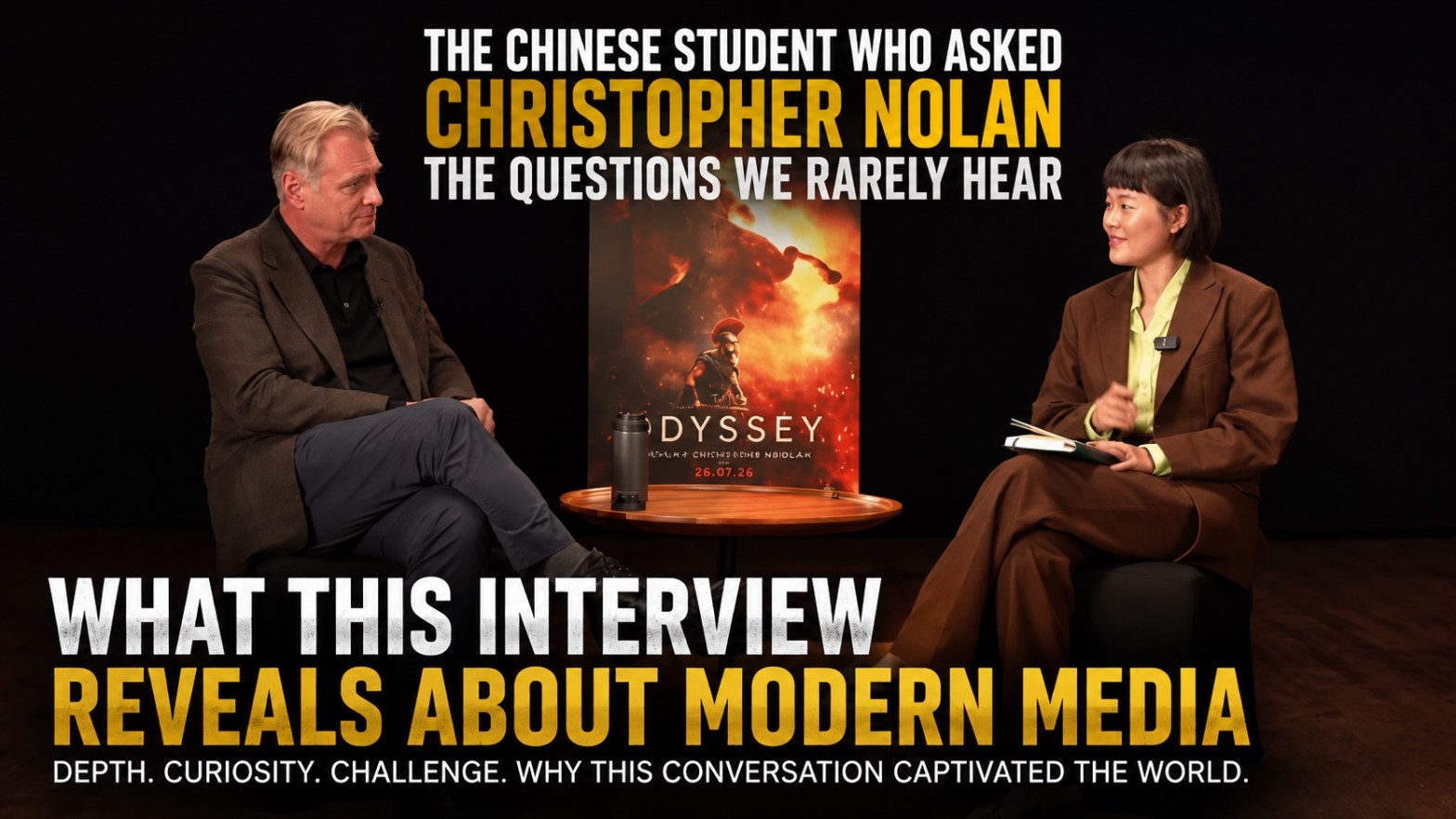
Attention Over Expertise: Lessons from Christopher Nolan’s Interview with a Chinese Student
A recent conversation between Beijing university student Yiyang Zhuge and filmmaker Christopher Nolan has quietly become one of the internet’s most talked-about interviews.
Not because Nolan unveiled some groundbreaking secret about The Odyssey. Not because the interviewer landed a dramatic “gotcha” question. And not because it generated a headline-worthy controversy.
Instead, people were captivated by something we’ve become surprisingly unfamiliar with: an intelligent conversation.
For nearly an hour, two people discussed literature, history, philosophy, artistic interpretation, and the enduring relevance of Homer’s Odyssey. The questions were deeply researched. The answers were thoughtful. Neither participant seemed interested in manufacturing a viral moment.
The overwhelming response says less about Christopher Nolan or Yiyang Zhuge than it does about the media environment we’ve created. For a brief moment, millions of people were reminded what genuine intellectual curiosity looks like. That alone is revealing.
The Disappearing Art of the Interview
Most modern celebrity interviews aren’t designed to explore ideas. They’re designed to produce clips. A celebrity eats progressively hotter chicken wings. Another plays games with a late-night host. Someone answers thirty rapid-fire questions while promoting their latest film. Every exchange is engineered for social media, where thirty seconds of personality consistently outperform thirty minutes of substance.
There’s nothing inherently wrong with entertaining interviews. They can be funny, charming, and genuinely enjoyable. The problem emerges when entertainment becomes the only language our culture speaks.
When actors spend more time discussing their coffee order than the themes they’ve spent years bringing to life on screen, audiences inevitably become starved for conversations that ask bigger questions. The Nolan interview stood out because it reminded us of what we’ve gradually lost.
This Isn’t Really About China
Many commentators have framed the interview as evidence that China’s education system has surpassed the West’s, or that Chinese intellectual culture is somehow fundamentally superior. That conclusion feels far too simplistic. Exceptional students exist everywhere.
A deeply curious undergraduate from Beijing, Toronto, New York, Cairo, or Oxford would likely approach a rare opportunity to interview Christopher Nolan in much the same way—with months of preparation, extensive reading, and a genuine desire to explore ideas rather than collect viral sound bites.
At the same time, we shouldn’t romanticize the circumstances.
China is not simply another educational system. It is a state with its own cultural ambitions, political priorities, and carefully managed public image. High-profile interviews involving internationally recognized figures almost certainly pass through layers of institutional approval. Ignoring that reality would be naïve.
But pretending Western media operates free from its own incentives would be equally naïve. Both systems shape narratives. The difference is that one often seeks to project intellectual prestige, while the other increasingly optimizes for engagement metrics. Neither deserves a free pass.
The Attention Economy
Perhaps the deeper issue isn’t that we’ve made entertainers famous. We’ve always celebrated entertainers. What’s changed is that we’ve begun treating fame itself as evidence of authority. Attention has become a credential.
Someone with fifty million followers is increasingly assumed to possess insight into politics, economics, education, medicine, foreign affairs, or philosophy simply because millions recognize their face. Algorithms make no distinction between expertise and popularity.
A historian who has devoted forty years to studying Homer competes for the same attention as an influencer reacting to celebrity gossip. More often than not, the influencer wins.
When Visibility Becomes Authority
This shift reaches far beyond Hollywood. Reality television personalities become presidents. Influencers shape public health conversations. Podcast hosts become geopolitical commentators.
Celebrity family members become authorities on subjects in which they have little meaningful expertise. Even established institutions increasingly recruit personalities before scholars because personalities already command audiences.
This isn’t an indictment of any particular individual. It’s an observation about incentives.
We’ve built a culture where visibility often comes before competence, and where experts are increasingly expected to justify why they deserve our attention instead of public figures having to justify why they deserve our trust.
The Information Age Was Never About Information
We often describe ourselves as living in the Information Age. That description no longer feels accurate. Knowledge has never been more accessible. Entire libraries fit inside our pockets. The world’s greatest university lectures can be streamed for free. Anyone with an internet connection can access research papers, online courses, historical archives, and centuries of human thought.
Access is no longer the problem. Attention is.
We’ve democratized attention far more successfully than we’ve democratized wisdom. Algorithms don’t reward the best ideas. They reward whatever keeps us watching for a few seconds longer. The result is a culture where expertise competes on equal footing with spectacle—and spectacle usually wins.
Why This Interview Resonated
Perhaps that’s why this conversation spread so quickly. People weren’t simply impressed by a remarkably well-prepared student.
They were relieved.
Relieved to watch two people treat one another—and the subject itself—with seriousness. There were no gimmicks. No manufactured outrage. No performative debates. No desperate attempts to create the next viral clip. Just an artist speaking with someone who had done the reading.
That felt extraordinary only because it has become so rare. And perhaps that’s the most uncomfortable realization of all.
If a thoughtful discussion about one of the foundational works of Western literature feels revolutionary in 2026, the lesson isn’t that intellectual depth has suddenly appeared somewhere new. It’s that we’ve allowed it to quietly disappear from many of the places where we once expected to find it.

