Backpacking with Technology: How eSIMs Provide Peace of Mind
Hey fellow travellers, digital nomads, and adventure seekers! Constantly on the move for design inspiration or capturing moments for my YouTube channel, staying connected is a non-negotiable part of my journey. In this blog post, I want to share with you how eSIMs have seamlessly become a game-changer in my tech arsenal, enhancing my travel experiences in ways I couldn’t have imagined.
Unlocking Boundless Connectivity: You know the struggle – arriving in a new country, dealing with local SIM cards, and the hassle of getting connected. Well, eSIMs have turned that scenario on its head for me. No more swapping physical cards or being tied down to one carrier.
Flexibility on the Go: Being a backpacker, flexibility is a must because I truly don’t know where I’ll be month after month. Whether I’m navigating the urban landscape or trekking through the wilderness, eSIMs provide unparalleled flexibility. No need to worry about changing plans or being restricted by geographical boundaries. It’s like having a reliable data provider that we always dreamed about.
Step 2: Use the code CFYPV22173 Receive 50% cashback (up to $5) on your first purchase!
Step 3: Turn on Roaming Here is where you travel without ever worrying about out of control bills.
Seamless Integration with My Digital Lifestyle: As a professional designer and content creator, my iPhone is more than just a phone – it’s a my business tool. With eSIMs, I seamlessly integrate connectivity into my digital lifestyle. No more hunting for local SIM cards, no more dealing with unreliable connections or local scams. I can capture and share my adventures with you in real-time, adding a whole new dimension to my travel content.
Budget-Friendly and Efficient: Backpacking often means being budget-conscious. Traditional roaming charges can quickly add up, putting a strain on your travel funds. With eSIMs, I’ve found a cost-effective solution. I can choose data plans that align with my budget, staying connected without breaking the bank. It’s all about maximizing resources for the experiences that truly define my backpacking adventure.
Let’s liberate ourselves from the expensive cords and contracts of traditional cell phone companies. Join me in exploring the world of backpacking with technology, where eSIMs offer the peace of mind necessary to fully immerse ourselves in the wonders of our journeys. Embrace the freedom, flexibility, and efficiency that eSIMs bring to your backpacking escapades, guaranteeing that every step of the way is captured and shared with the world.
Use the code CFYPV22173 to receive 50% cashback (up to $5) on your first purchase!
Key Takeaways from His Teachings and Works | Timeless Wisdom for Aspiring Designers
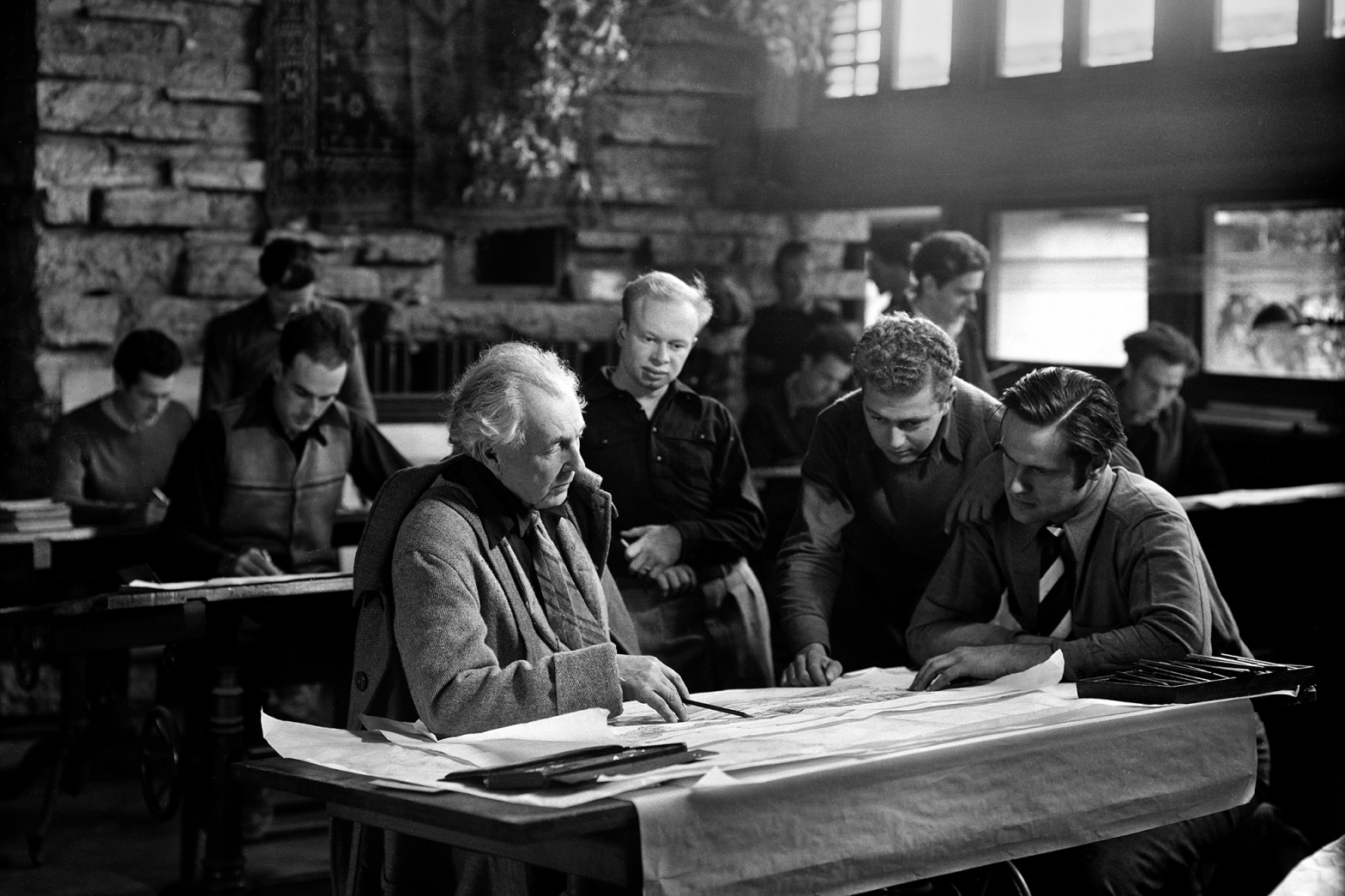
Today, I find myself reflecting on the profound influence Frank Lloyd Wright has had on my life. It all began in my first year of high school, back in September 2000, when I was introduced to Wright’s masterpiece, Falling Water, in my AutoCAD class. Tasked with researching a building and creating a series of plans using the software, I found myself drawn to this architectural marvel.
With just a few images, I was captivated. The building’s harmony with nature, its bold cantilevers, and the innovative use of materials sparked a fascination that has only grown over the years. In the years that followed I dove deep into Wright’s work, studying his construction methods, the stories of his on-site work, and his legendary live work studio practices.
As my understanding of Wright’s work grew, so did my desire to experience his architecture firsthand. I began to travel, seeking out his buildings, each visit became a modern day pilgrimage to the physical manifestations of his architectural philosophy.
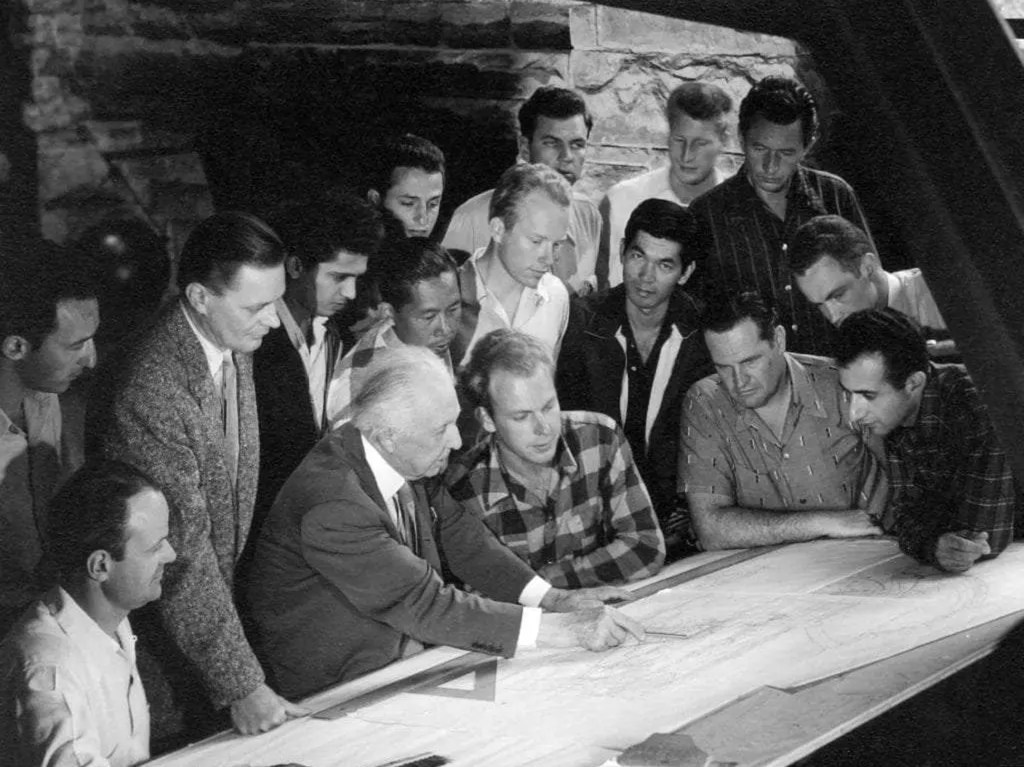
Today, I revisited a list of advice Wright once gave to young architects. His words resonate with me as much today as they did when I first encountered them:
Forget the architecture of the world except as something good in their way and in their time.
Do none of you go into architecture to get a living unless you love architecture as a principle at work, for its own sake – prepared to be as true to it as to your mother, your comrade, or yourself.
Beware of the architectural school except as the exponent of engineering.
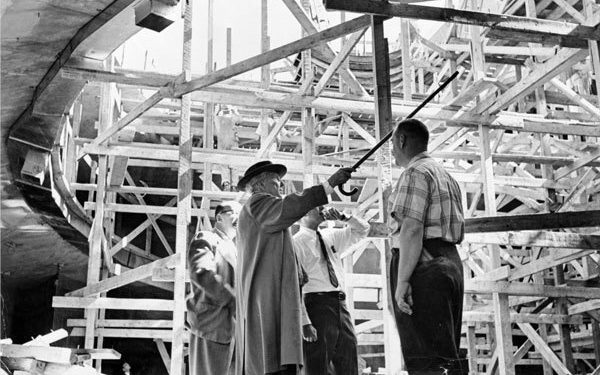
Go into the field where you can see the machines and methods at work that make the modern buildings, or stay in construction direct and simple until you can work naturally into building-design from the nature of construction.
Immediately begin to form the habit of thinking “Why” concerning any effects that please or displease you.
Take nothing for granted as beautiful or ugly, but take every building to pieces, and challenge every feature. Learn to distinguish the curious from the beautiful.
Get the habit of analysis, analysis will in time enable syntheses to become you habit of mind.
“Think in simples” as my old master (Louis H. Sullivan) used to say, meaning to reduce the whole to its parts in simplest terms, getting back to first principles. Do this in order to proceed from generals to particulars and never confuse or confound them or yourself be confounded by them.
Abandon as poison the American idea of the “quick turnover.” To get into practice “half-baked” is to sell out your birthright as an architect for a mess of pottage, or to die pretending to be an architect.
Take time to prepare. Ten years’ preparation for preliminaries to architectural practice is little enough for any architect who would rise “above the belt” in true architectural appreciation or practice.
Then go as far away as possible from home to build your fist buildings. The physician can bury his mistakes-but the architect can only advise his client to plant vines.
Regard it as just as desirable to build a chicken-house as to build a cathedral. The size of the project means little in art, beyond the money-matter. It is the quality of character that really counts. Character may be large in the little or little in the large.
Enter no architectural competition under any circumstances except as a novice. No competition ever gave to the world anything worth having in architecture. The jury itself is a picked average. The first thing done by the jury is to go through all the designs and throw out the best and the worst ones so, as an average, it can average upon an average. The net result of any competition is an average by the average of averages.
Beware of the shopper for plans. The man who will not grubstake you in prospecting for ideas in his behalf will prove a faithless client.
These words, a reflection of Wright’s philosophy, serve as a guiding light in my architectural journey. They remind me of the importance of understanding the nature of construction, of thinking critically, and of maintaining integrity in my work. As I continue to explore Wright’s legacy, I am reminded of the power of building to inspire, challenge, and transform.
The quote “Do none of field where you can see the machines and methods at work that make the modern buildings, or stay in construction direct and simple until you can work naturally into building-design from the nature of construction” Wright emphasizes the importance of gaining practical experience and understanding the processes involved in constructing modern buildings.
Wright suggests that aspiring architects should immerse themselves in the field, where they can witness firsthand the machines and methods used in the construction industry. By doing so, they can develop a deep understanding of the technical aspects of building and how they influence design.
Alternatively, Wright advises staying involved in construction directly, working on projects that are straightforward and uncomplicated. This hands-on experience allows architects to develop a natural understanding of building design, rooted in the practicalities and constraints of construction.
In essence, Wright encourages architects to have a strong foundation in the realities of construction before delving into the complexities of architectural design. By gaining practical knowledge and experience, architects can create designs that are not only aesthetically pleasing but also functional and feasible in the context of construction.
A Snapshot of the Cubist Revolution with Picasso’s Still Life with Chair Caning
Imagine a world where artists were once shackled to the pursuit of picture-perfect perfectionism, devoting countless hours to mastering techniques that would allow them to create images from a single vantage point and moment in time. This was the reality for centuries, as artists strove to capture the world around them with painstaking accuracy.
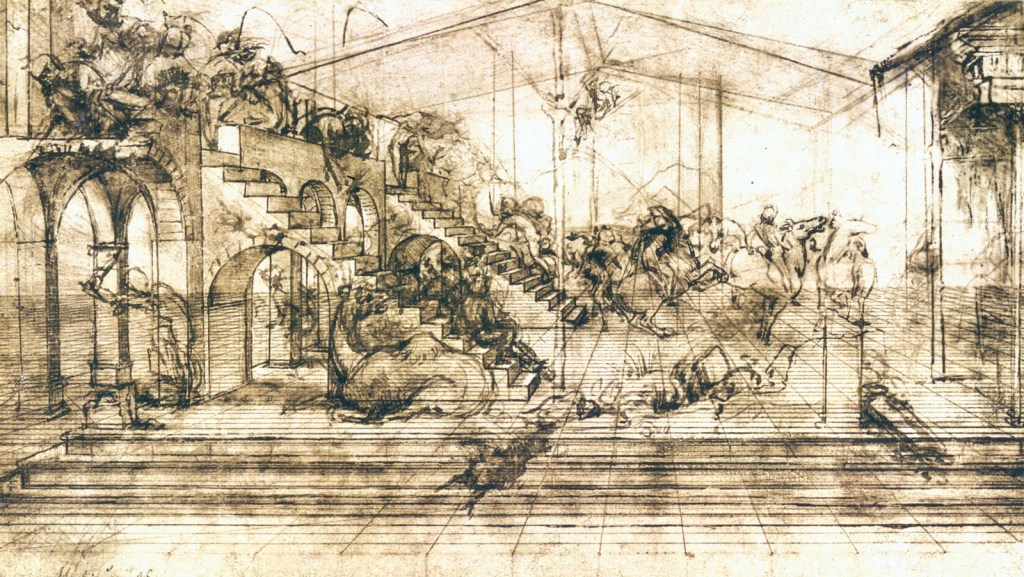
Devoting countless hours to mastering techniques that would enable them to create images from a single vantage point and moment in time was an arduous endeavour for artists. This pursuit delved deep into the realms of math and science, particularly in the form of linear perspective. The artist’s journey became intertwined with principles of geometry, as they meticulously studied the convergence of lines and the vanishing points that brought depth and dimension to their creations.
Through intricate calculations and precise measurements, they sought to recreate the world as it appeared to the naked eye, meticulously aligning every element to capture the essence of reality. Hours turned into days, days into weeks, and weeks into years, as artists painstakingly honed their skills, understanding the intricate relationship between angles, distances, and proportions. It was a laborious dance between artistry and science, where the brush became an instrument of mathematical precision, and the canvas became a stage where the principles of perspective took centre stage.
But then, something remarkable happened: the advent of photography and the camera.
Apache still life c1907 Edward S Curtis
Amidst the realm of painstaking artistic and mathematical endeavours to perfect linear perspective, a striking moment of fear gripped the soul of creators. The emergence of the camera cast a shadow of uncertainty, threatening to render their painstaking efforts instantly obsolete. Doubt permeated their thoughts, envisioning a future where they were reduced to mere imitators of reality.
However, amidst the initial unease and uncertainty, a profound transformation unfolded. Artists embarked on a journey of self-discovery, recognizing the camera’s potential as a tool for artistic expression. Rather than an adversary, the camera became a catalyst, inspiring the birth of Modernist movements in art and opening doors to unexplored realms of creativity.
Embracing this newfound realization, artists broke free from the shackles of imitation and ventured into the uncharted territories of the abstract and imaginative. With each brushstroke and pen stroke, they declared their independence, shattering conventions and delving into the multifaceted dimensions of perception.
Their audacious endeavours sparked a revolution that swept across the artistic landscape. Cubism, Impressionism, and Abstract Modernism flourished, infusing the art world with renewed vitality. Witnessing this metamorphosis, a new generation of artists emerged from guilds and academies, forever altering the creation and experience of art. The abstract and visionary triumphed over the confines of realism, breathing fresh life into the very essence of artistic expression.
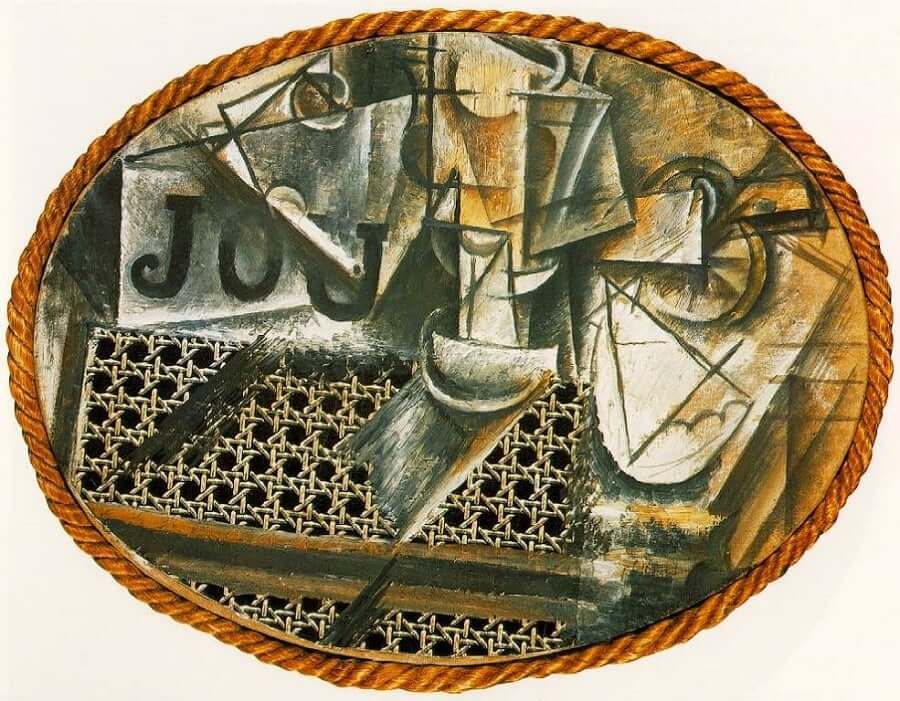
Enter Cubism, a groundbreaking avant-garde movement pioneered by visionaries like Pablo Picasso and Georges Braque during the early 1900s. Cubism sought to dismantle the long-held belief in the illusionistic portrayal of reality. By deconstructing and reconstructing figures and elements, it challenged the notion that paintings should merely serve as windows into our familiar world. Picasso’s Still Life with Chair Caning stands as a testament to the transformative power of this movement, pushing boundaries and paving the way for a new era in artistic exploration.
Still Life with Chair Caning, Pablo Picasso, 1912.
In this iconic work, Picasso presents multiple views of the elements within the artwork, such as the disfigured pipe and wine glass, illustrating their components from various angles. In doing so, he captures the illusion of time in a still life painting, a concept that seems paradoxical until we consider the fleeting and ever-changing nature of our own experiences, and time itself. This innovative approach to art reflects a more abstract yet wonderfully imaginative way of perceiving the world through the mind’s eye. Picasso’s fearless abandonment resonates so deeply, forging an undeniable connection with virtually all avant-garde art to follow for the next century.
While initially appearing as a mix of forms, a closer look reveals a captivating composition waiting to be deciphered. In the upper right corner, a knife handle catches the eye, leading to its blade slicing through a citrus fruit. The rind and segments of the fruit are discernible at the bottom right corner of the blade. Below the fruit, a scalloped edge represents a white napkin.
Through the fragmented perspectives of Synthetic Cubism, Picasso challenges conventional visual interpretation. By unraveling the details within Still-Life with Chair Caning, we enter a world of multiple viewpoints, inviting us to explore the rich tapestry of artistic expression.
Moreover, Picasso’s use of collage in Still Life with Chair Caning raises provocative questions about the nature of art, perspective, and the minds eye itself. By incorporating elements of time and space, he forces us to confront the distinction between sight and memory, and whether the inclusion of such elements expands the universe of and realm of perspective. In doing so, Picasso suggests that art may be more about philosophical exploration than about creating convincing replicas of the limited reality we experience in mere snapshots of time and space.
The evolution of art from the pursuit of picture-perfect perfectionism to the more abstract and imaginative realms of perception can be traced back to the advent of photography and the camera. This technological innovation liberated artists from the constraints of single-perspective realism, allowing them to explore new ways of seeing and understanding the world around them. As a result, movements like Cubism emerged, forever changing the way we perceive and appreciate art.
History as it does, did not stop there, the evolution of artistic expression did not end with the advent of photography and modern art. As technology continued to advance, so did the possibilities for capturing and representing the world. A significant leap came with the emergence of time-based photography, also known as video. This revolutionary medium opened up a whole new realm of image-making, documentation, and artistic exploration.
With the ability to capture a sequence of images in rapid succession, artists and visionaries were now able to convey not just a single frozen moment but the passage of time itself. Video photography offered a dynamic and immersive experience, allowing viewers to witness events unfold, stories unfold, and narratives unravel right before their eyes.
The creative and scientific implications of this breakthrough were profound. Artists could now delve into the essence of movement, capturing the fluidity and rhythm of gestures, the changing interplay of light and shadow, and the unfolding of complex scenes. Scientific researchers found new avenues to study motion, behaviour, and natural phenomena with unprecedented detail and accuracy.
The transformative power of time-based photography not only expanded our creative horizons but also reshaped our perception and understanding of reality. It challenged the notion that an image could only depict a single frozen moment, instead embracing the fluidity and continuous nature of existence. The combination of photography, Cubism, and time-based media propelled the art world and the realm of human perception into new frontiers, forever altering the way we perceive, appreciate, and interact with art.
Inspiring Moments at the Kyoto Museum of Contemporary Art
As an art and history enthusiast, I have always been fascinated by the interplay between traditional and contemporary art forms. My recent visit to the Kyoto Museum of Contemporary Art (MoMAK) offered me a unique opportunity to explore this dynamic relationship in the context of Japanese art and architecture.
Upon entering the museum, I was immediately struck by the harmonious blend of traditional and modern architectural elements. The building itself is a testament to the seamless integration of Japan’s rich cultural heritage with contemporary design principles.
The museum building makes extensive use of varied materials: stone, glass, steel. The outer wall is made of Portuguese granite. Its gray, textured surface is imposing, but on stepping inside, visitors encounter a radically different white marble space. As they walk further and encounter the stairs, they find railings made from a combination of steel and glass.
Another notable point is that the staircase columns are coloured vermilion or grey. Architect Maki said, “I intend to create a seemingly ‘De Stijl’ world.” Among the works in the MoMAK collection is Composition (1872-1944) by Piet Mondrian, leader of the De Stijl group, and at the museum, wrapped in its grid of tiles, rooms, and layers, it is said that visitors can experience a world such as Mondrian envisioned.
The museum was designed by architect Maki Fumihiko. Over the more than 30 years since its construction in 1986, they have held nearly 300 exhibitions. However, MoMAK is not only a venue for exhibitions, as many students and architects visit the museum specifically to view the architecture, today I was here for both.
The series of exhibits at the MoMAK provided a comprehensive overview of the evolution of Japanese art, from its traditional roots to its current manifestations in the contemporary art scene. One of the highlights of my visit was the exhibit featuring Dada works by Max Ernst and Francis Picabia, as well as “readymades” of Marcel Duchamp represented by his Fountain, and collage works by Hannah Höch and Kurt Schwitters.
The works on display showcased the artists’ innovative use of materials and techniques, reflecting their desire to break free from traditional artistic constraints. It was inspiring to witness their confidence in challenging established norms and pushing the boundaries of creative expression.
Kurt Schwitters (1887-1948), a leading figure in Hanover, Germany who’s work spanned several genres and media, including Dadaism, constructivism, surrealism, poetry, sound, painting, sculpture, graphic design, typography, and architecture — much of which later came to be known as installation art, is best known for “Merz,” his own term for his practice of making assemblages and collages using discarded materials, scraps of paper, tickets and other objects and fragments found on city streets. Underlying this ongoing project was his experience of World War I and his belief that “everything is ruined, the task is to build something new out of the rubble.”
As an avid collector and archivist of paper-based artifacts from my travels, my visit to the MoMAK became an unexpectedly delightful exploration of artistic intersections, particularly when reflecting on the work of Kurt Schwitters. Little did I know that my personal fascination with preserving tickets, beer labels, museum tickets, flyers, and other memorabilia would find resonance in the surprising overlap between Dadaism and contemporary Japanese art.
The Dadaist artists, with their bold defiance of convention, redefined the boundaries of artistic expression by incorporating ordinary objects into their works. This innovative approach mirrored my own fascination with collecting and preserving paper-based mementos from my travels. Just as the Dadaists saw artistic potential in the everyday, I, too, found joy in uncovering the narratives and significance embedded within seemingly ordinary items.
What struck me during my exploration of the museum was the unexpected convergence between my personal collecting habits and the artistic practices prevalent in contemporary Japanese art. Like the Dadaists, Japanese artists embraced the transformative power of found objects and collages, infusing their works with a sense of cultural significance and personal expression.
In Japan, the reverence for the beauty of impermanence and the value of transitory moments resonates deeply. This connection became apparent as I delved into my collection of paper artifacts, realizing that they, too, captured fleeting moments and preserved them in a tangible form. The act of cherishing and archiving these items mirrored the Japanese cultural practice of honouring and preserving objects that hold personal or cultural significance.
In Japan, paper holds a deep-rooted significance that stems from historical moments and cultural practices. The country’s reverence for paper can be traced back to ancient times when it was introduced from China. Throughout history, Japan has developed its unique papermaking techniques, such as washi, characterized by its exceptional quality and craftsmanship.
Paper has played a pivotal role in various aspects of Japanese culture. From the elegant art of calligraphy to the delicate art form of origami, paper has been a medium of artistic expression and a vehicle for preserving cultural traditions. The fragility and impermanence of paper are valued in Japan, reflecting the concept of “mono no aware,” which appreciates the beauty of transient moments and the fleeting nature of existence.
Additionally, Japan’s profound respect for nature is intertwined with its affinity for paper. The traditional use of natural fibers, such as mulberry, bamboo, and hemp, in papermaking reflects the country’s harmonious relationship with the environment. This sustainable approach aligns with the Japanese philosophy of living in harmony with nature, known as “wa,” and resonates with their deep appreciation for simplicity and natural beauty.
Furthermore, historical moments like the Heian period (794-1185) and the development of the tea ceremony during the Edo period (1603-1868) contributed to the elevated status of paper in Japan. In the Heian period, the production and use of paper expanded, leading to the creation of literary masterpieces like “The Tale of Genji.” During the Edo period, paper was instrumental in the art of the tea ceremony, where meticulously crafted washi was used for calligraphy, tea utensils, and the construction of tearooms.
Through this unexpected encounter, I discovered a profound parallel between the innovative spirit of Dadaism and the essence of Japanese art. Both celebrated the potential of everyday materials to evoke deeper meanings and create connections between personal experiences, cultural expressions, and artistic innovation.
Another standout exhibit was the collection of modern Japanese calligraphy, which showcased the works of renowned calligraphers such as Shiryū Morita and Yūichi Inoue. The exhibit highlighted the artists’ groundbreaking styles and techniques, which pushed the boundaries of traditional calligraphy and introduced new forms of expression. Witnessing their confidence and boldness in exploring new avenues of creativity was truly captivating.
The exhibition of modern Japanese calligraphy showcased the groundbreaking works of calligraphers like Shiryū Morita and Yūichi Inoue, drawing intriguing parallels with modern American artists, such as the renowned Jackson Pollock. Both Morita, Inoue, and Pollock share a common approach to art, where the process itself becomes as significant as the final result. They push the boundaries of their respective art forms by embracing experimentation, spontaneity, and unconventional techniques. Morita and Inoue challenge traditional calligraphy by introducing new forms of expression, while Pollock’s revolutionary “drip painting” technique redefined the concept of artistic creation. Their boldness and confidence in exploring new avenues of creativity captivate viewers, reminding us that art is a living, evolving process that engages both the artist and the audience. The exhibition offered a thought-provoking experience, connecting the innovative practices of Japanese calligraphers and modern American artists like Pollock, highlighting the universal nature of artistic exploration across cultures and time.
As I moved through the exhibition, I couldn’t help but feel an increasing sense of inspiration and awe. The evolving confidence of the artists was palpable, and their willingness to take risks and embrace innovation resonated with me on a profound level. The art became more powerful, as if it was imbued with a newfound vitality that emanated from the artists’ growing assurance in their creative endeavours.
The MoMAK role in promoting contemporary Japanese art cannot be understated. By providing a platform for both established and emerging artists, the museum fosters a vibrant artistic community that continually pushes the boundaries of creative expression. Furthermore, the museum’s commitment to showcasing the interplay between traditional and contemporary art forms serves as a reminder of the importance of preserving cultural heritage while embracing innovation.
As I reflect, my visit to the Kyoto Museum of Contemporary Art was an enlightening and inspiring experience. The museum’s architecture, exhibits, and the evolving confidence of the artists left a lasting impression on me. As I moved through the exhibition, I felt a growing sense of inspiration and connection with the art. I highly recommend a visit to the MoMAK for anyone interested in exploring the dynamic relationship between tradition and innovation in the world of art.
As I continue to delve into the world of art and explore the dynamic interplay between tradition and innovation, I am inspired to embrace the unexpected and seek out the extraordinary in the seemingly mundane. This remarkable encounter at the museum has enriched my perspective, reminding me of the profound stories waiting to be discovered within the fragments of everyday life.
Challenging Perceptions | The Power of Art to Transform Perspectives
During my visit to the Kyoto Museum of Contemporary Art (MoMAK), I was captivated by an exhibition that combined surrealist installations with thought-provoking works exploring currency. This unique exhibit featured pieces by renowned artists such as Genpei Akasegawa, Marcel Duchamp, André Breton, and René Magritte, as well as works by artists from the alternative art school known as Bigakkō.
One of the standout pieces in the exhibit was Genpei Akasegawa’s “Zero Yen-Note” from 1967. Akasegawa’s work challenges our understanding of currency and its value, using art to question the very foundations of our economic systems.
The life of Akasegawa Genpei is the rich and diverse history of Japan’s post-war avant-garde art movement. As an artist who actively participated in anti-government protests, Akasegawa’s art was deeply rooted in the social and political context of his time.
His engagement with Dadaism, an art movement characterized by its rejection of traditional aesthetics and embrace of absurdity, further demonstrates his commitment to challenging established norms and pushing the boundaries of artistic expression.
As a post-modernist, Akasegawa questioned the very nature of art and its role in society, exploring themes of appropriation, reproduction, and the relationship between art and everyday life.
Through his diverse experiences and contributions to various artistic movements, Akasegawa Genpei’s legacy serves as a powerful reminder of the transformative potential of art and its ability to reflect and shape the world around us. His work can be further explored at here.
The Zero Yen Note is an artistic concept created by Genpei Akasegawa, a Japanese artist. It was introduced in the late 1960s as a form of satirical commentary on the consumer-driven society and the perceived value of money. The Zero Yen Note was designed to resemble a real banknote but had a denomination of zero yen, implying that it holds no monetary value.
Akasegawa intended the Zero Yen Note to challenge the notion of worth and question the significance society places on money. By creating a currency with no financial value, he aimed to provoke contemplation about the nature of currency, the concept of ownership, and the role of art in society. The Zero Yen Note also served as a statement against consumerism and the relentless pursuit of material wealth.
Through this artistic concept, Akasegawa encouraged viewers to reassess the value systems that govern our lives, prompting them to consider alternative forms of worth beyond monetary measures. The Zero Yen Note became a symbolic representation of the power of imagination, creativity, and the potential for transcending material possessions.
Another intriguing work on display was a 2002 sculpture by Kazuya Kusuhara, which featured a U.S. banknote with all the ink scraped off using a sand eraser, leaving only a faint shadow of US President Lincoln on the paper. This piece, like Akasegawa’s, invites viewers to reconsider the nature of currency and the perceived value we assign to it.
Modern artists have often utilized currencies as a medium for artistic expression. They manipulate banknotes, coins, and other forms of currency to challenge societal norms and explore themes related to economics, power, and identity. By altering or incorporating currency into their artwork, artists aim to provoke thought and critique the established systems of value and exchange. This can involve interventions such as printing new designs, altering existing currency, or creating entirely new currencies, blurring the line between art and money. Through these artistic interventions, artists seek to stimulate dialogue about wealth, consumerism, globalization, and the ways in which currency shapes our lives.
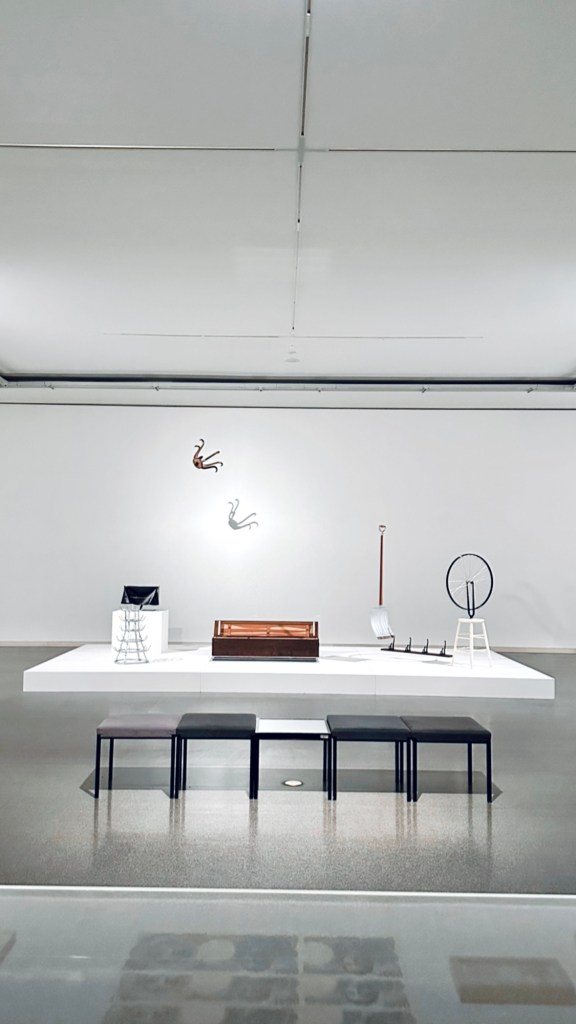
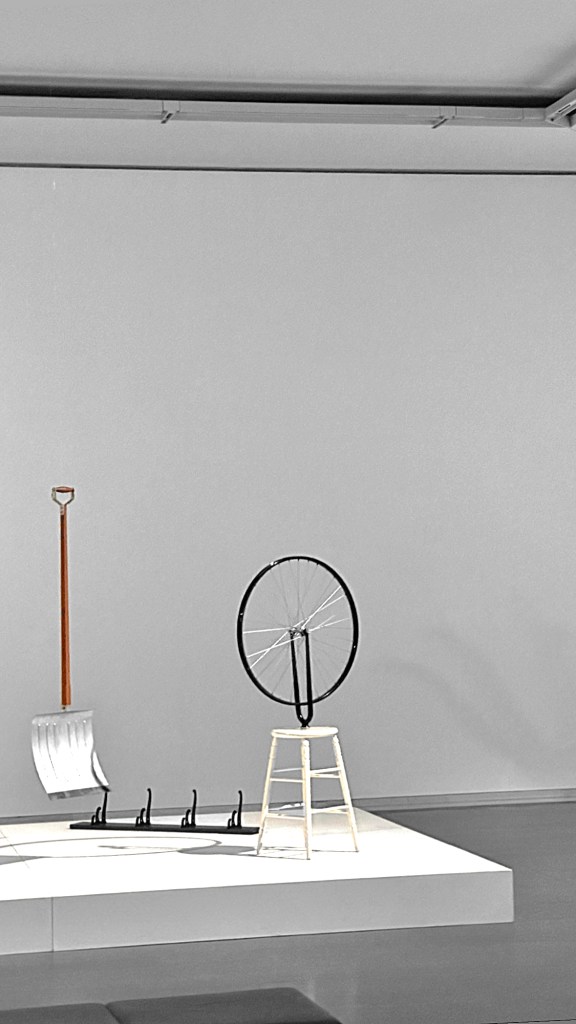
The exhibit was split between these innovative works by artists from Bigakkō and early surrealist pieces, such as Marcel Duchamp’s “Bicycle Wheel” and “Fountain,” as well as a series of sculptural pieces by André Breton and René Magritte. The juxtaposition of surreal objects with distortions and manipulations of currency, bills, and banknotes created a thought-provoking exploration of consumption, perceived value, and established ideas and notions.
The combination of surrealism and currency-focused art in this exhibit offered a fresh perspective on the role of art in challenging societal norms and questioning the foundations of our beliefs. By presenting these works side by side, the MoMAK encouraged visitors to engage in a dialogue about the nature of value, the power of art to disrupt established systems, and the potential for creative expression to inspire change.
As I departed the gallery, I found myself once more delving into the notions and themes that fuel and invigorate my perception of value in life. It was especially delightful to reconnect with the surrealist art movement, a source of defiant inspiration for countless creative souls, including my teenage self. The surrealism and currency exhibit served as a revitalizing reminder of the stimulating and captivating experiences that not only provoke contemplation but also encourage sharing through the transformative power of art. By challenging our perspectives and igniting fresh ideas, art truly bridges the gap between society and the human experience.
Exploring Tokyo’s Nightlife and Trendsetting Youth Culture Where Tradition Meets Modernity in a Captivating Urban Escape
Tokyo, a city that never sleeps, unveils its true essence as the sun sets and the neon lights come alive. In this immersive journey, we delve into the heart of the metropolis, strolling past traditional Izakayas with their captivating red lanterns, ascending to the futuristic Muiyashita Rooftop Park, and venturing into the iconic Shibuya scramble. Join me as we uncover the hidden treasures, fashionable trends, and pulsating energy that make Tokyo a captivating playground for the youth and Gen-Z.
The Allure of Izakayas and their Red Lanterns As the night unfolds, we find ourselves walking through the narrow alleys adorned with the warm glow of red lanterns. These traditional Izakayas beckon passersby, inviting them to step into a world of cozy ambiance and delectable Japanese cuisine. The fragrant aromas wafting from the open doors entice us to explore further, while the subtle sounds of laughter and clinking glasses create a harmonious backdrop. It’s in these hidden corners where the authentic spirit of Tokyo resides, cherished by locals and cherished by tourists seeking an unforgettable experience.
Ascending to the Futuristic Muiyashita Rooftop Park Leaving behind the enchanting world of Izakayas, we find ourselves climbing to the futuristic Muiyashita Rooftop Park. As we reach the summit, a breathtaking panorama of Tokyo’s skyline unfolds before our eyes. The city’s towering buildings blend seamlessly with the starlit sky, evoking a sense of awe and wonder. Amidst the futuristic setting, we’re captivated by the vibrant presence of Tokyo’s youth and Gen-Z. Their vibrant fashion choices and avant-garde styles bring an element of modernity to this urban oasis. It’s a meeting point of generations, where tradition intertwines with the spirit of innovation.
Getting Lost in the Iconic Shibuya Scramble From the rooftop, we descend into the pulsating heart of Tokyo – the iconic Shibuya scramble. As we immerse ourselves in the chaos, we’re swept away by the energy and liveliness of this renowned intersection. The streets are adorned with colossal billboards and vibrant neon signs that flicker in a synchronized rhythm. The fashion-forward individuals, effortlessly stylish, add splashes of colour to the bustling cityscape. Lost in the sea of people, we become part of the urban symphony, where the echoes of footsteps and laughter merge into a melodic tapestry.
Unveiling the Hidden Atmosphere of Basketball Street Wandering through the labyrinthine streets, we chance upon the bustling and boisterous Basketball Street. Towering signs, illuminated with vibrant colours, compete for our attention, showcasing the latest trends and promoting unique offerings. The scent of street food fills the air as vendors offer delectable treats to hungry passersby. Amidst the hustle and bustle, we discover hidden alleyways that harbour intriguing cafes and boutique shops, offering an escape from the crowd. It’s these tucked-away gems that add depth to Tokyo’s vibrant tapestry, inviting us to explore beyond the surface.
Tokyo at night is a sensory wonderland, a symphony of lights, sounds, and emotions. From the allure of traditional Izakayas to the futuristic charm of Muiyashita Rooftop Park, and the captivating chaos of Shibuya scramble to the hidden treasures of Basketball Street, this city offers an experience that leaves an indelible mark on the soul. It’s in these detailed moments, the vibrant signage, the ever-evolving fashion, and the hidden atmosphere
A Paradise for Wildlife Lovers: Nara Deer Park’s Endearing Sika Dee
Embarking on a two month-long trip to Japan, I had high expectations of immersing myself in its rich culture, captivating landscapes, and architectural marvels. Little did I know that my visit to Nara Deer Park would turn out to be an extraordinary experience that exceeded all my wildest dreams. From the moment I arrived, the enchantment of this remarkable place unfolded before my eyes.
As I made my way from Osaka to Nara, anticipation coursed through me. Stepping foot into Nara Deer Park, I was greeted by a surreal sight – majestic deer strolling freely amidst visitors, almost as if they were residents of the park. What truly took my breath away was witnessing these gentle creatures bowing politely, their eyes sparkling with anticipation for the deer crackers in my hand. It was a truly mind-blowing experience, a testament to the harmonious coexistence between humans and nature.
The park itself, spanning a vast expanse, revealed a picturesque landscape that seemed to be painted by an artist’s brush. Lush green meadows stretched as far as the eye could see, dotted with ancient trees whose branches whispered tales of centuries gone by. Tranquil ponds mirrored the beauty of the surroundings, reflecting the azure sky above.
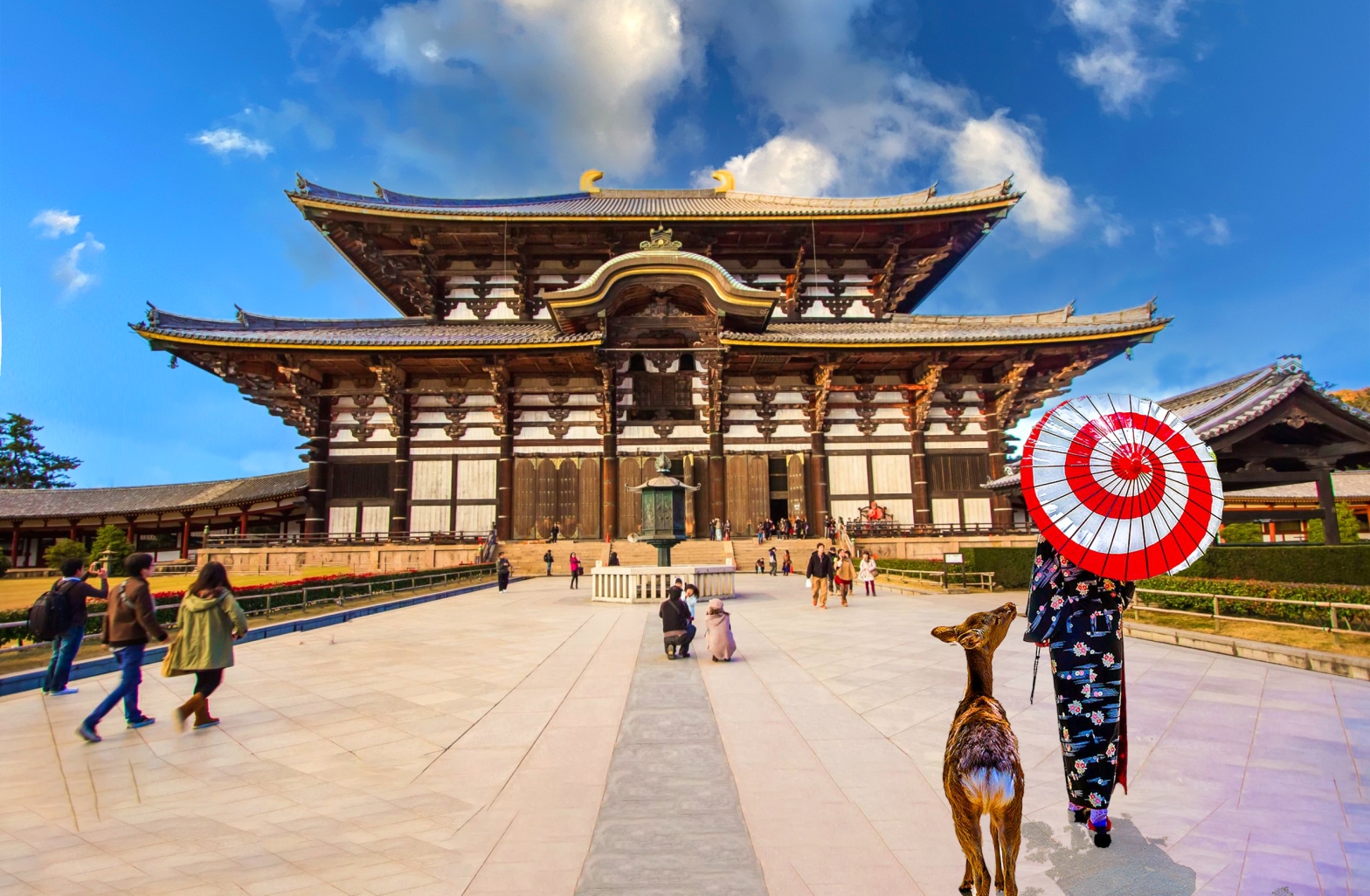
But it wasn’t just the natural splendor that captivated me. As an architect, I was drawn to the awe-inspiring temples nestled within the park. One of the most remarkable structures was the Todai-ji Temple, a colossal wooden edifice that stood as a testament to architectural ingenuity. The magnitude of the structure left me in awe, and as I stepped inside the Great Buddha Hall, the atmosphere shifted. I found myself standing before an immense bronze Buddha statue, its serene expression exuding an aura of tranquility. The intricate details and craftsmanship that went into creating such a masterpiece were truly remarkable.
The allure of Nara Deer Park extended beyond the deer and temples. It was a haven for spiritual seekers, as I discovered upon visiting the Kasuga Taisha Shrine. The pathway leading to the shrine was lined with thousands of stone lanterns, creating an ethereal atmosphere. Stepping into the shrine, I was enveloped by a sense of reverence. The architecture and design of the shrine reflected a unique blend of elegance and simplicity, captivating my architect’s eye.
Throughout my time in Nara Deer Park, I reveled in the perfect harmony of nature, tradition, and architectural wonders. The park offered a sanctuary where the boundaries between humans and animals dissolved, where the beauty of the natural world coexisted seamlessly with the magnificence of human creations.
As I bid farewell to Nara Deer Park, a profound sense of gratitude filled my heart. The memories of strolling amidst the deer, witnessing their gentle bows, and being in the presence of such extraordinary temples will forever be etched in my mind. This journey had not only opened my eyes to the wonders of Japan but had also left an indelible mark on my soul. Nara Deer Park is a place where dreams are realized, where nature whispers its secrets, and where the legacy of ancient traditions lives on, waiting to be discovered by those who seek enchantment.
So, pack your bags and embark on a journey to Nara Deer Park. Let the majestic deer, breathtaking landscapes, and awe-inspiring temples become a part of your own extraordinary adventure. Discover the magic that awaits in this remarkable corner of the world.
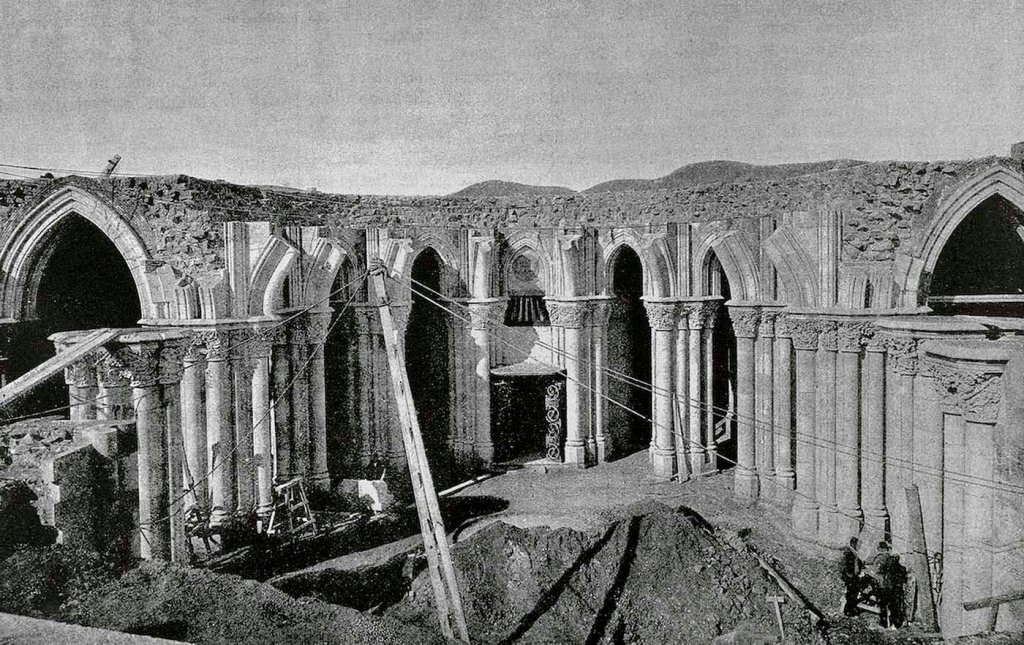
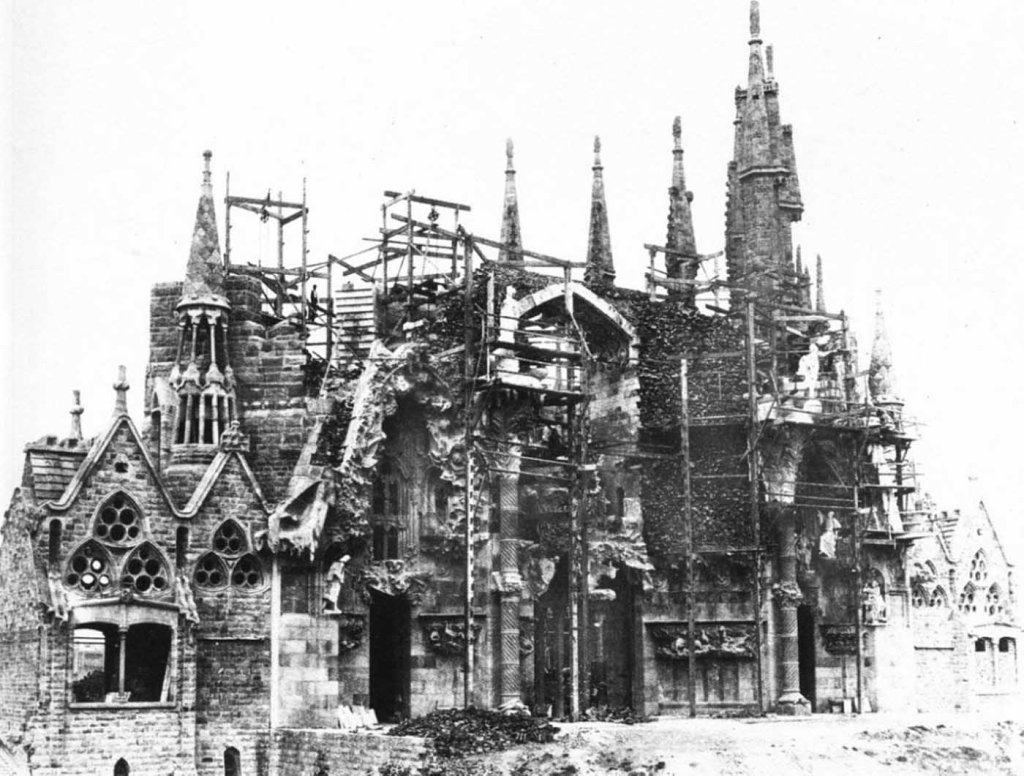
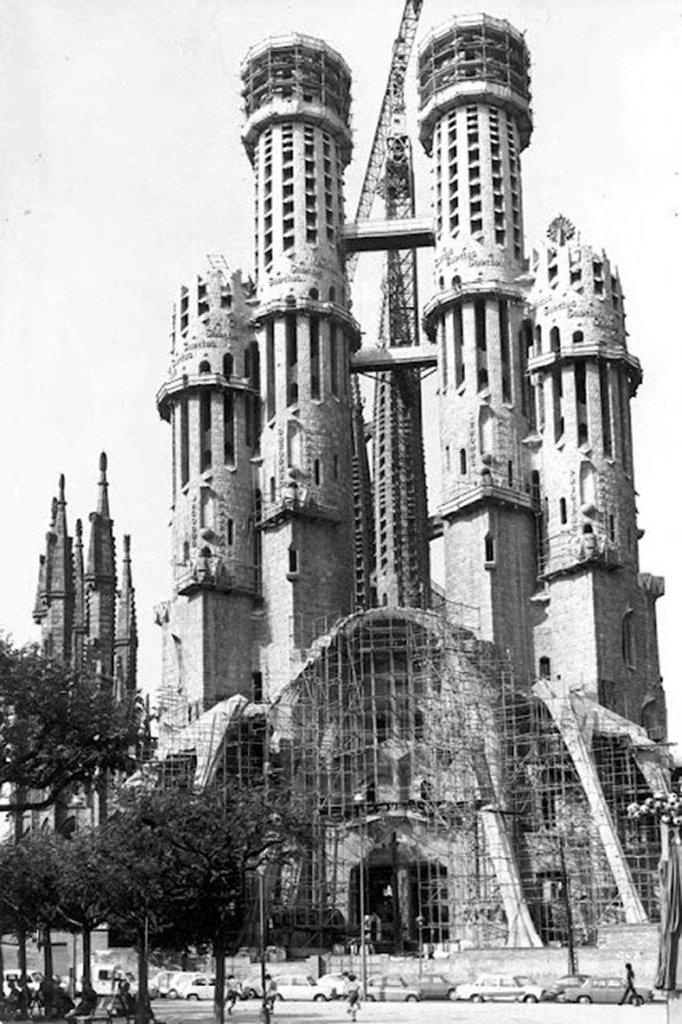
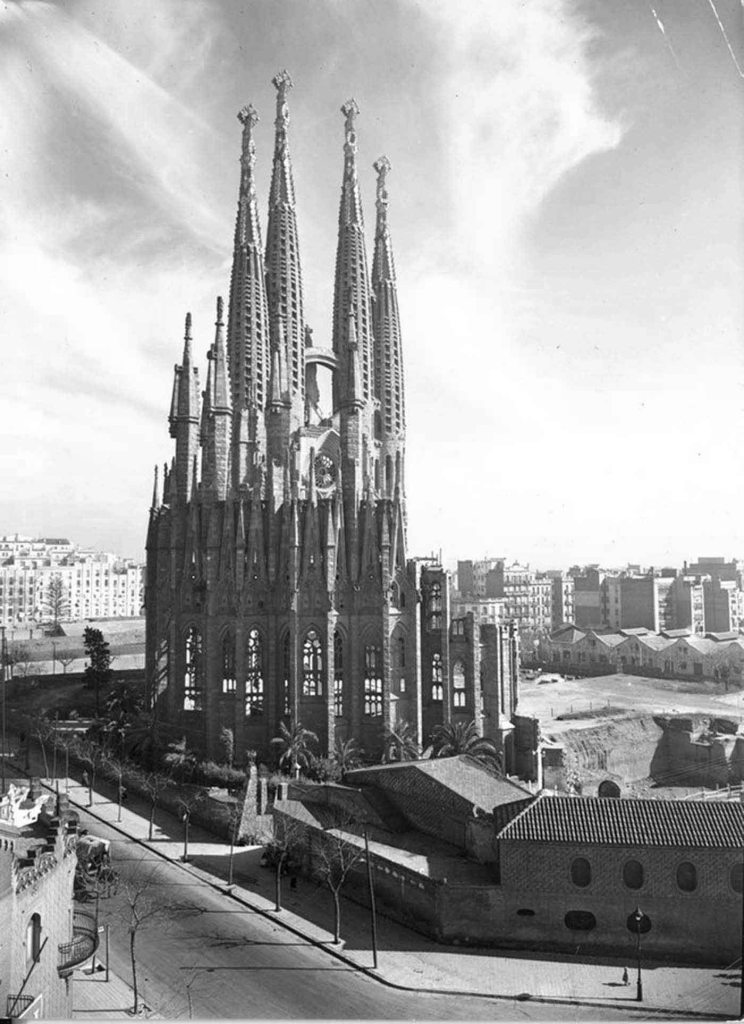
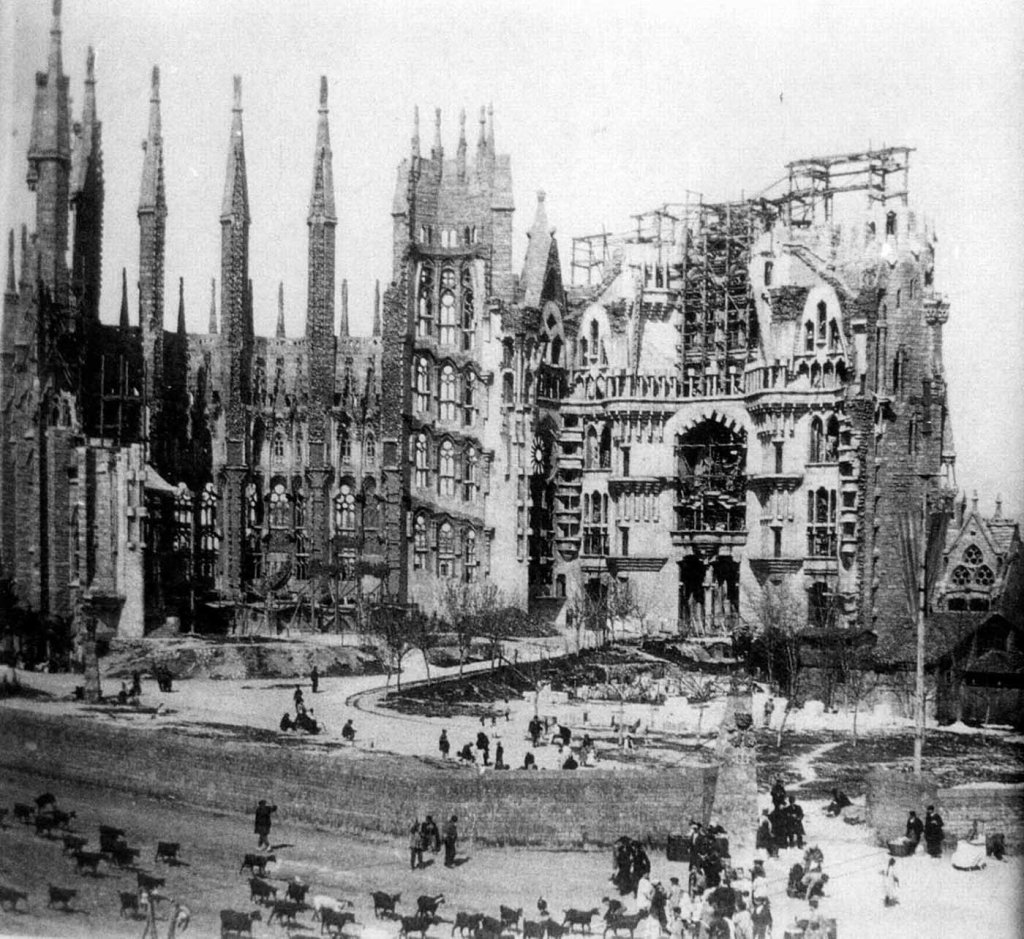
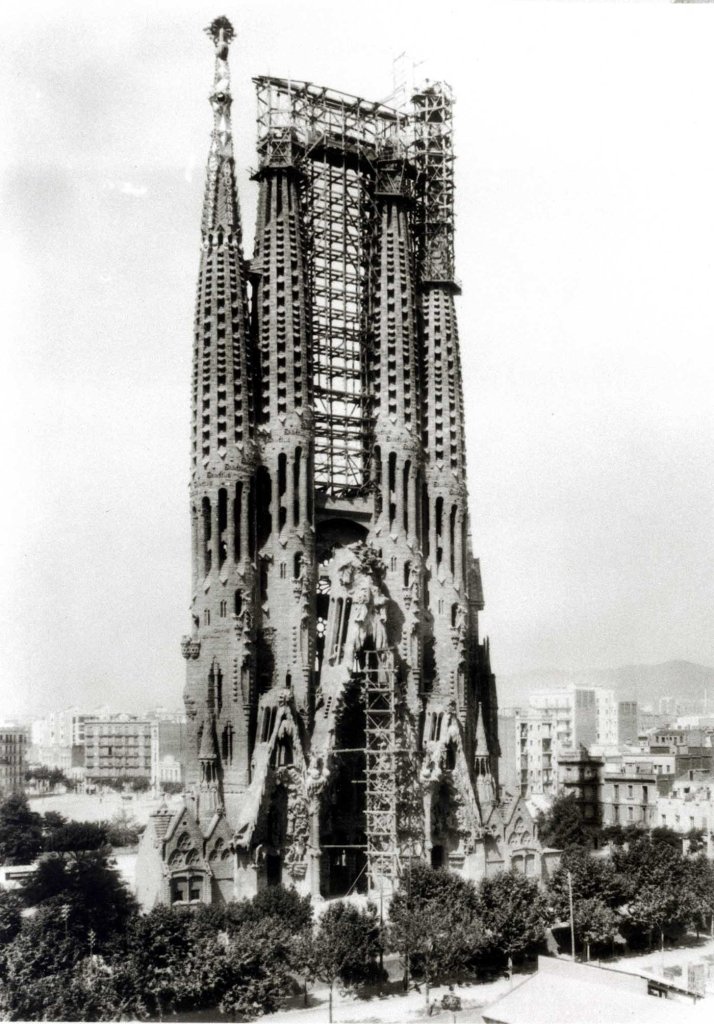
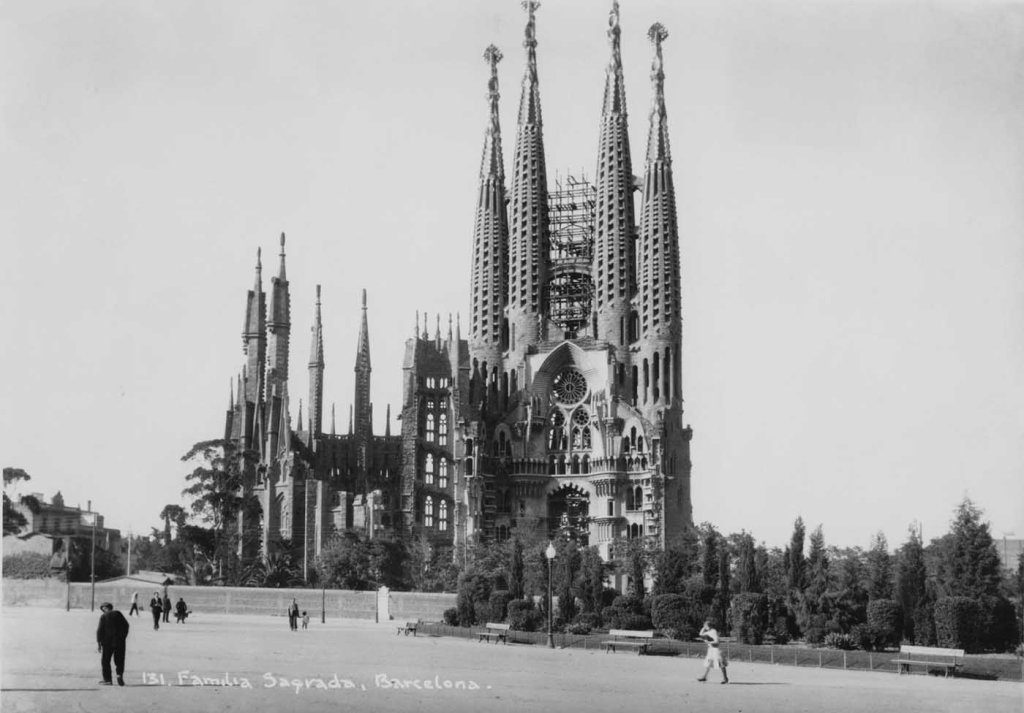
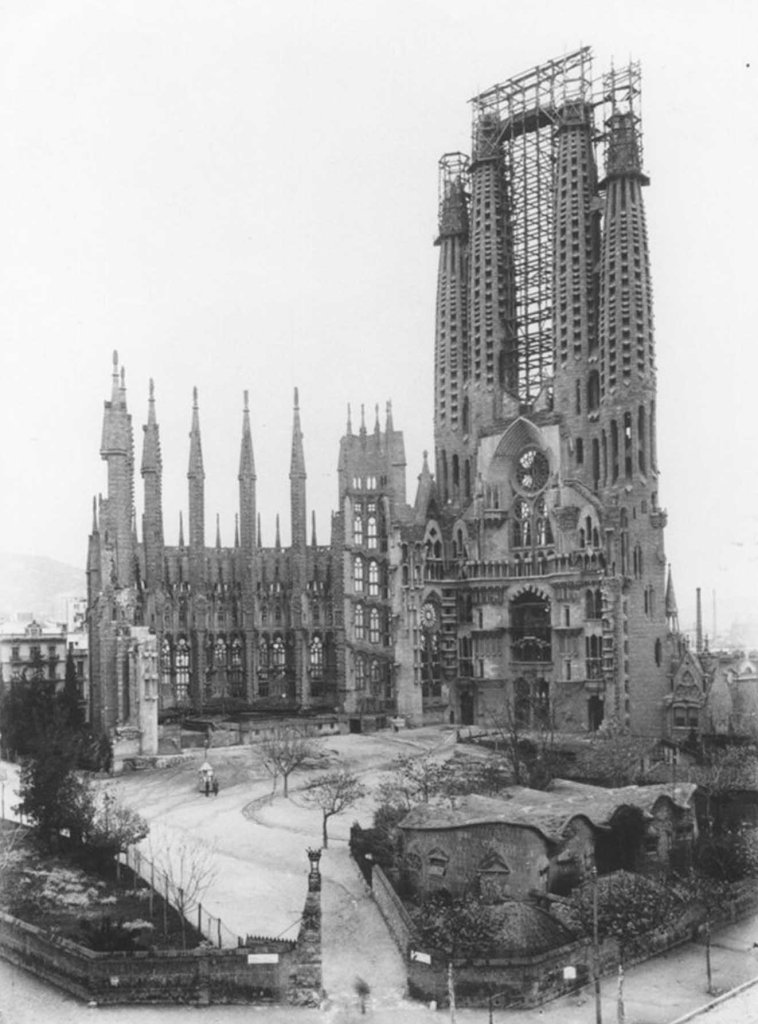
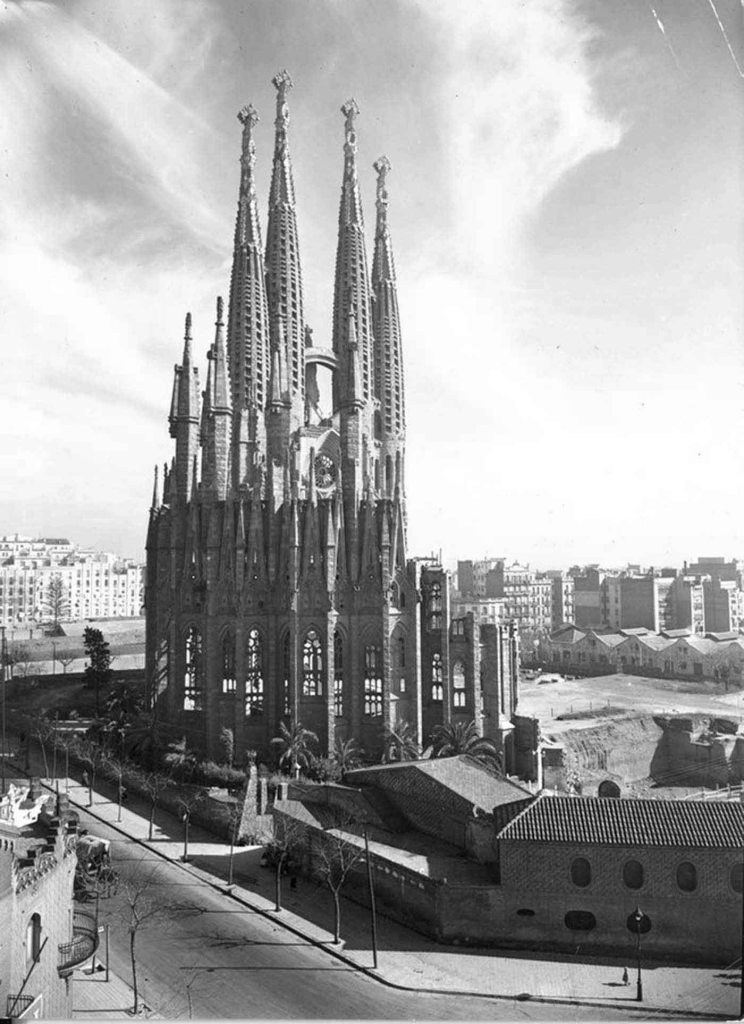
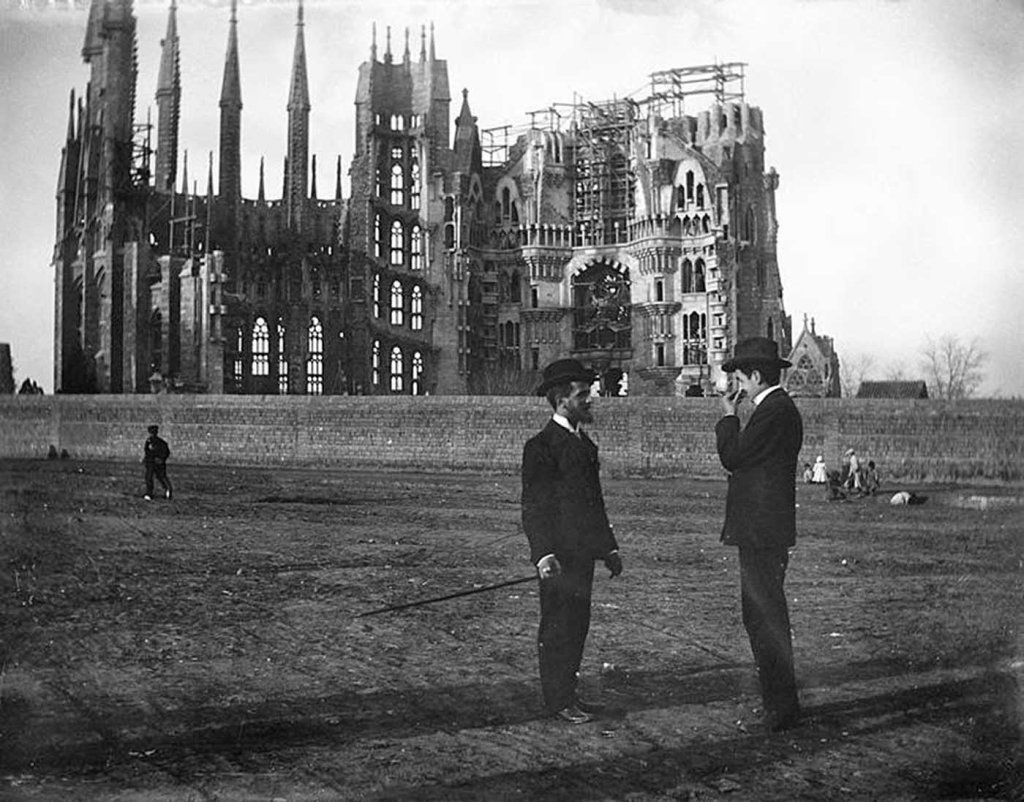
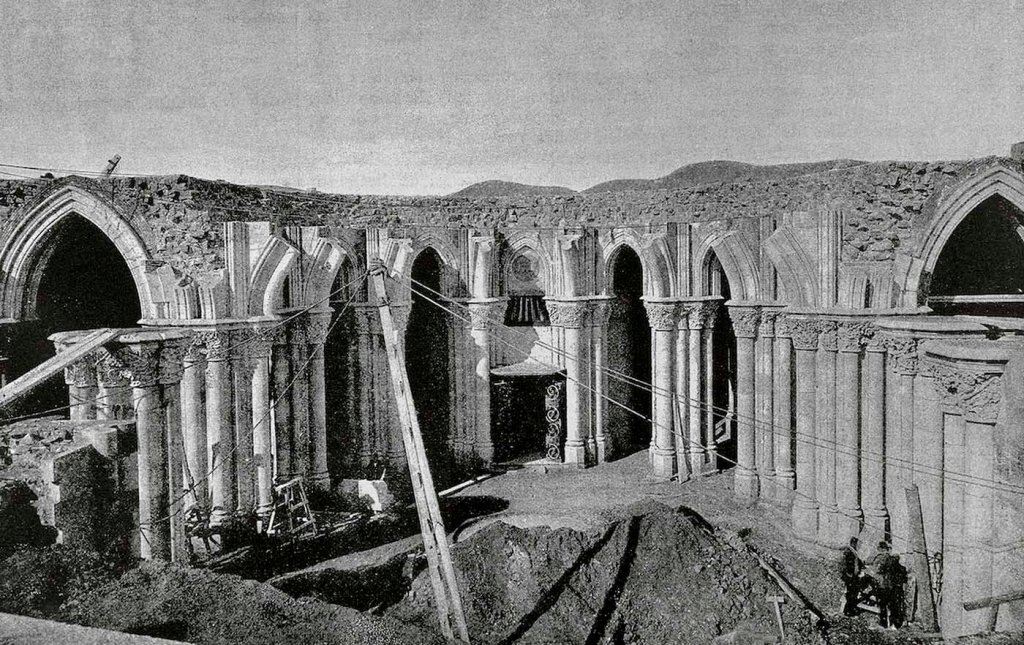
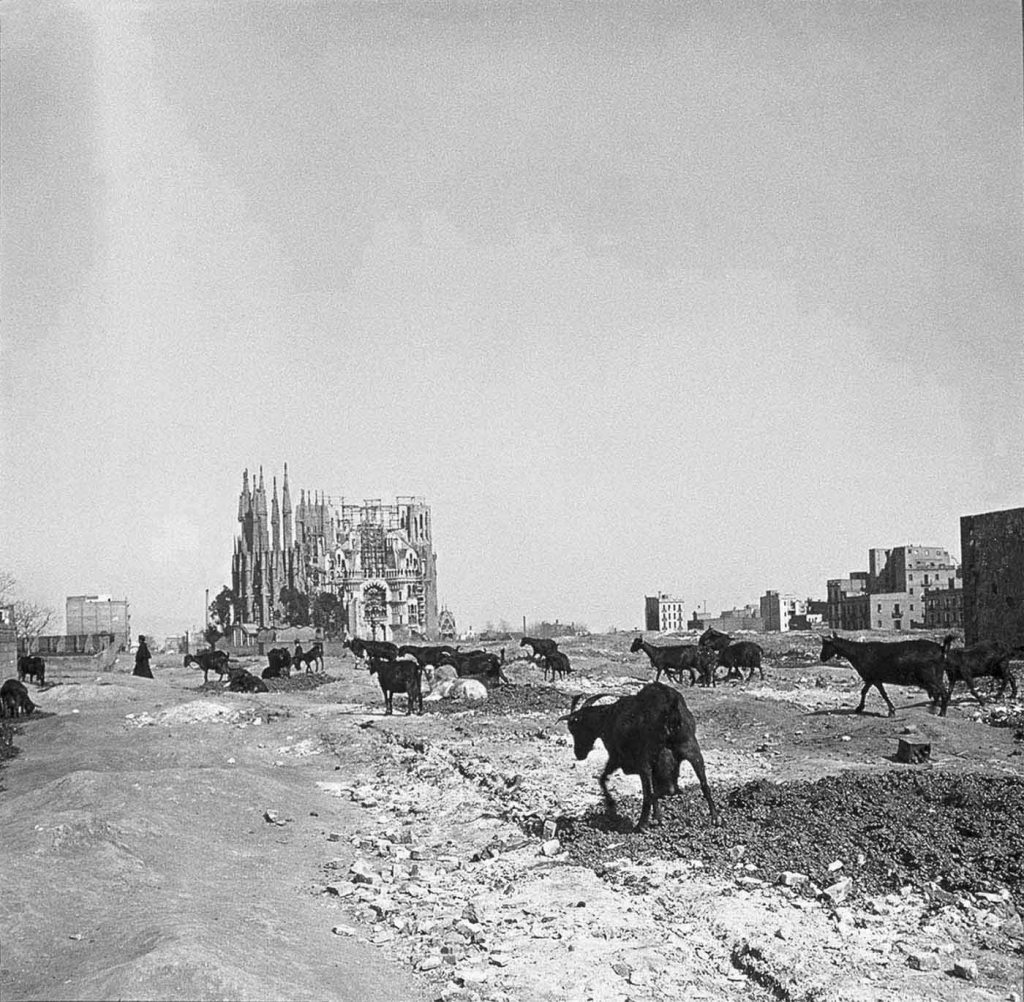
Original La Sagrada Familia under construction, 1887.
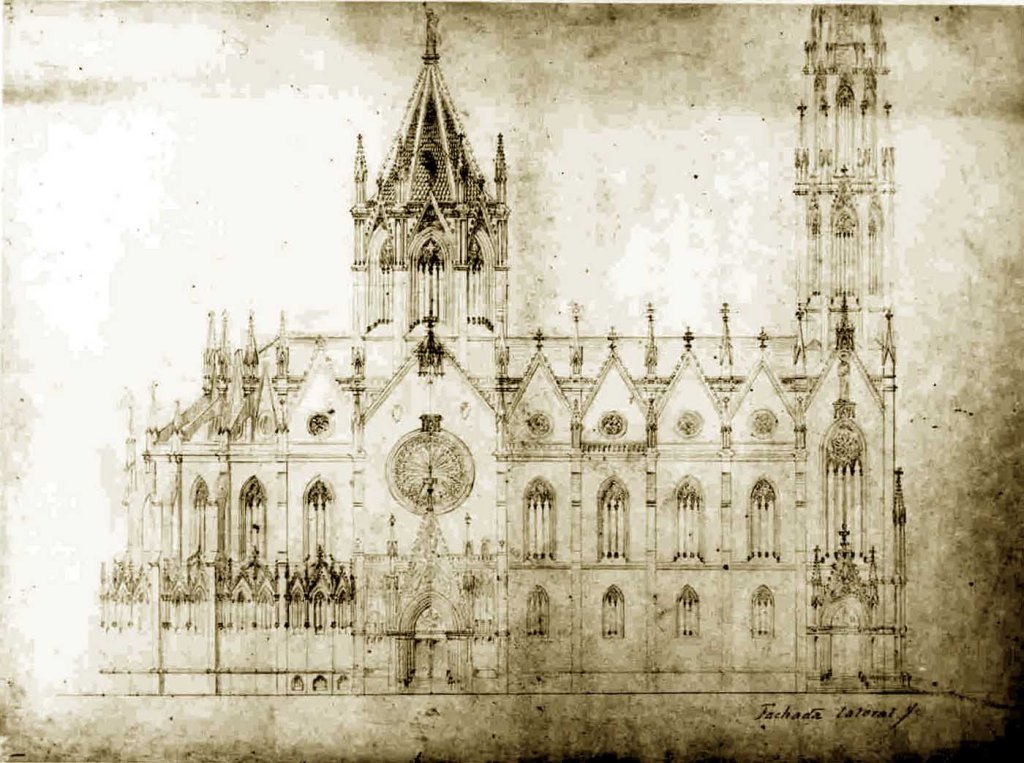
Antonio Gaudí embarked on a remarkable journey in 1883 when he first set out to design what he initially called the “church of the poor.” As an architectural enthusiast with a penchant for captivating designs, I found myself utterly fascinated by the intricate process that unfolded. Gaudí, renowned for his visionary creations in Barcelona, held an unwavering desire to craft something truly extraordinary—a vision that he would ultimately bring to life. In his later years, he bid farewell to all secular endeavors and devoted himself entirely to the awe-inspiring basilica known as La Sagrada Família, or the “Holy Family.”
For over four decades, Gaudí poured his heart and soul into this ambitious project, dedicating the final 15 years of his life to its realization. When asked about the seemingly endless duration of the construction, he would often jest, “My client is not in a hurry.” Together with a team of skilled artists, he meticulously supervised every aspect of the work until his tragic demise on June 7, 1926, when a city tram tragically claimed his life. To my astonishment, due to his disheveled appearance and empty pockets, several taxi drivers hesitated to offer him a ride, fearing he wouldn’t be able to pay the fare.
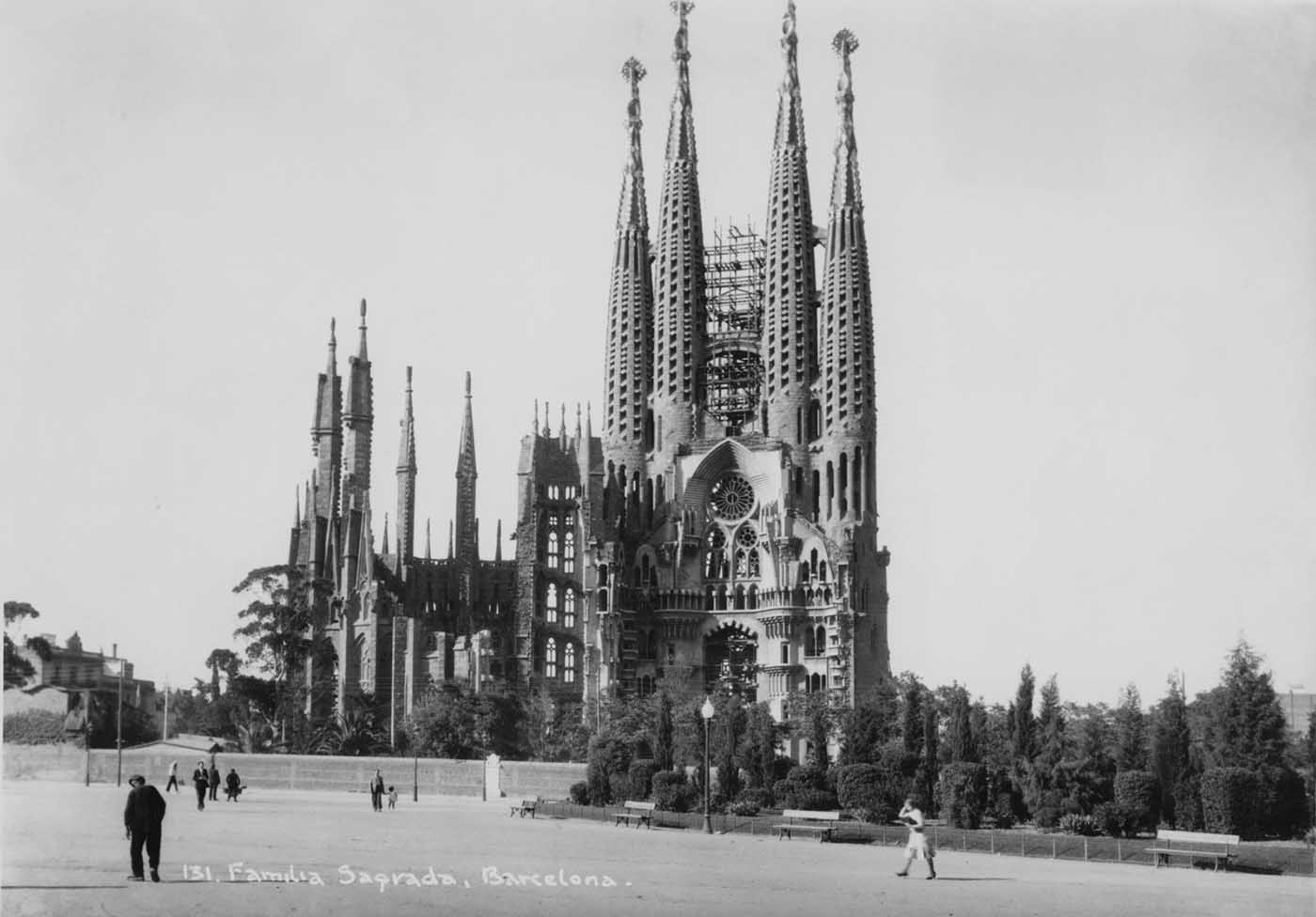
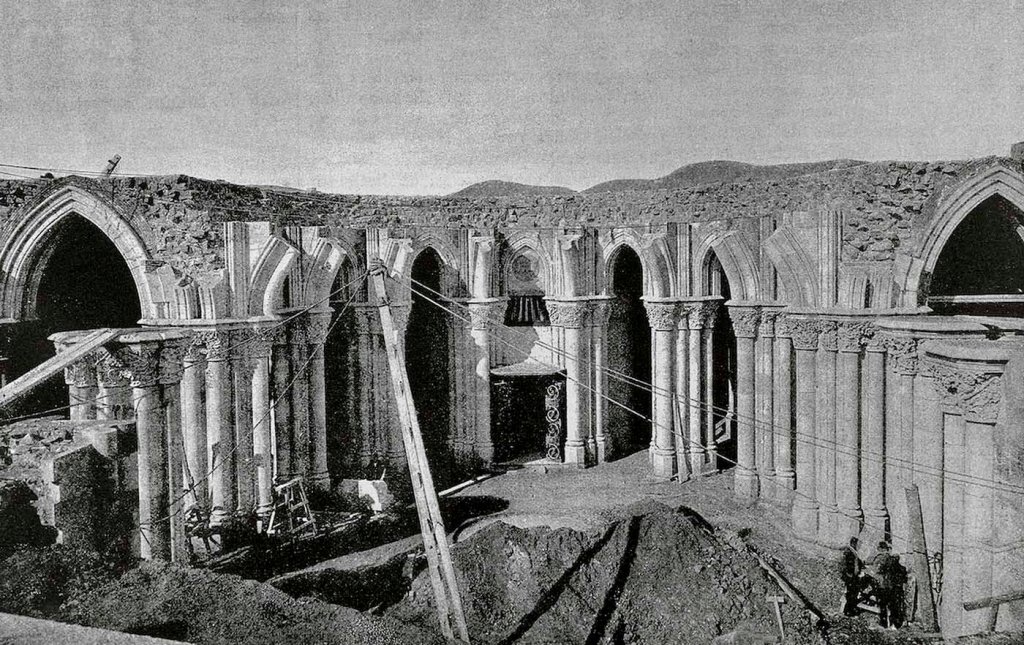
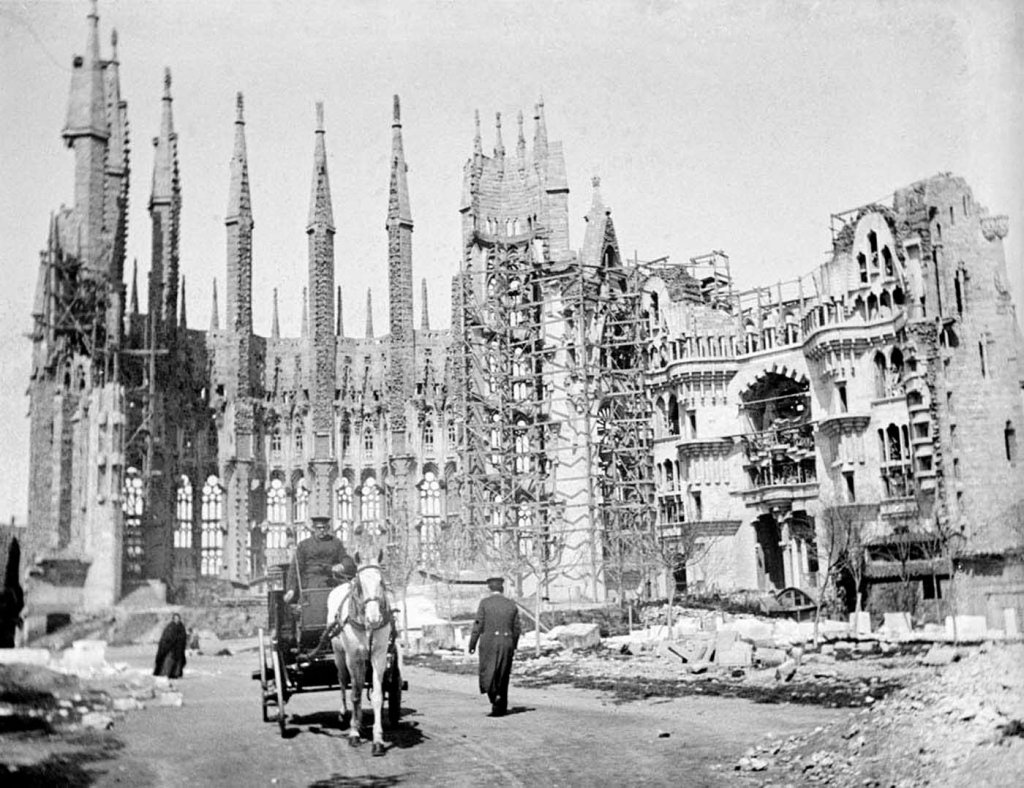
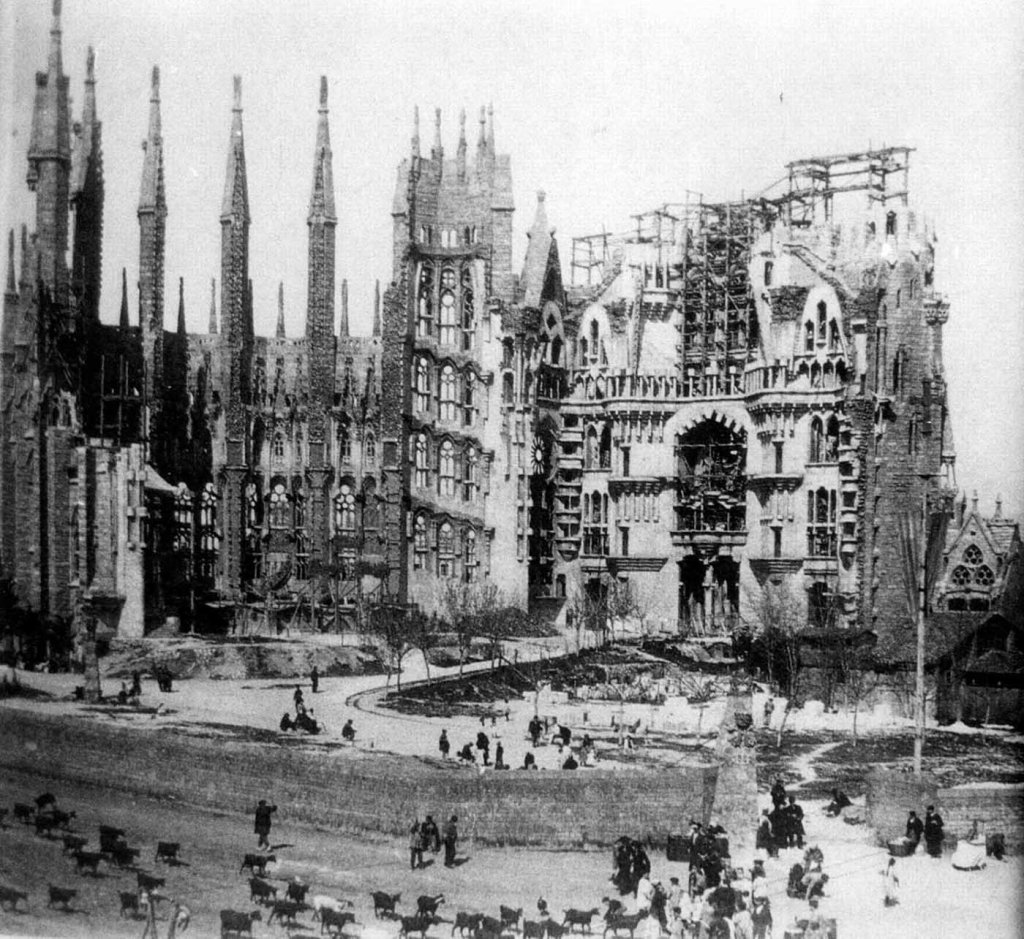
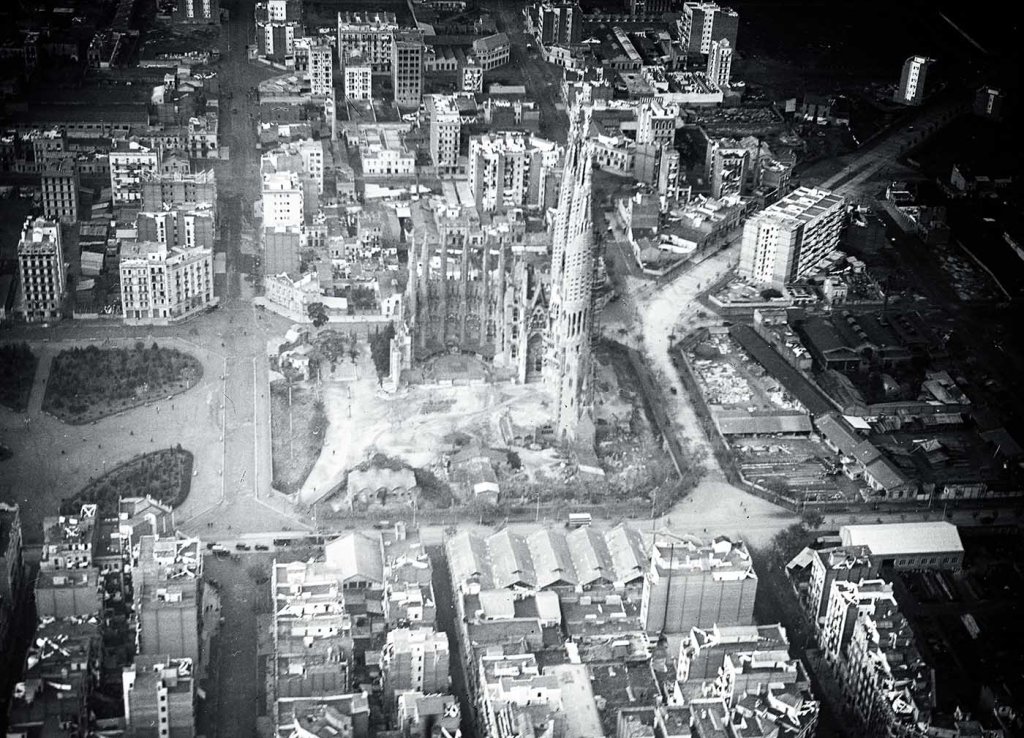
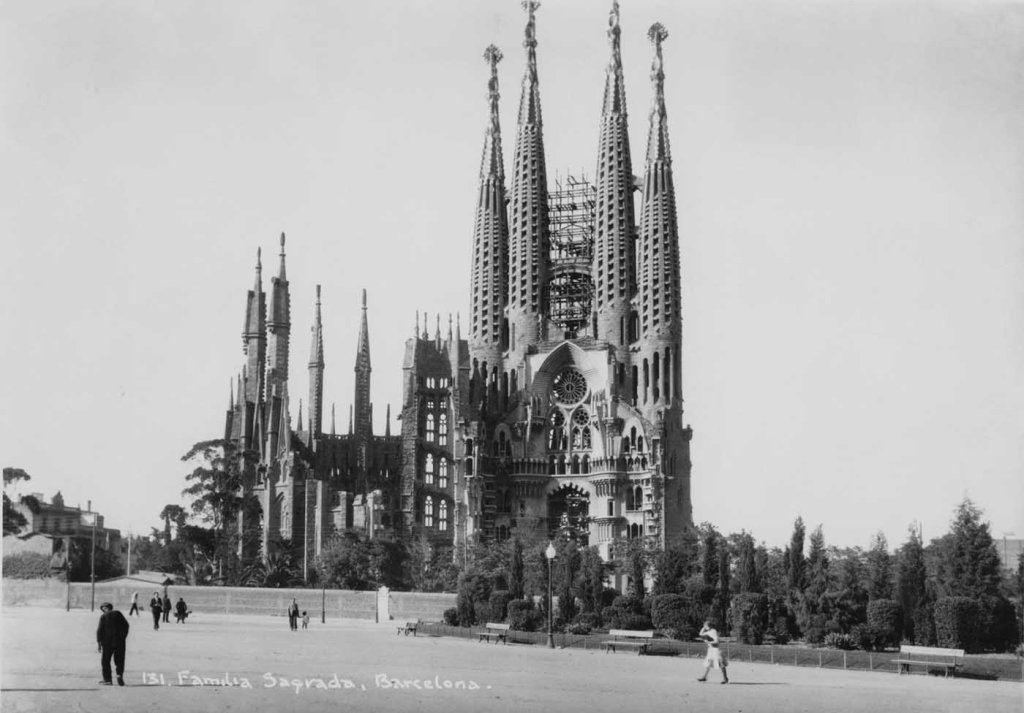
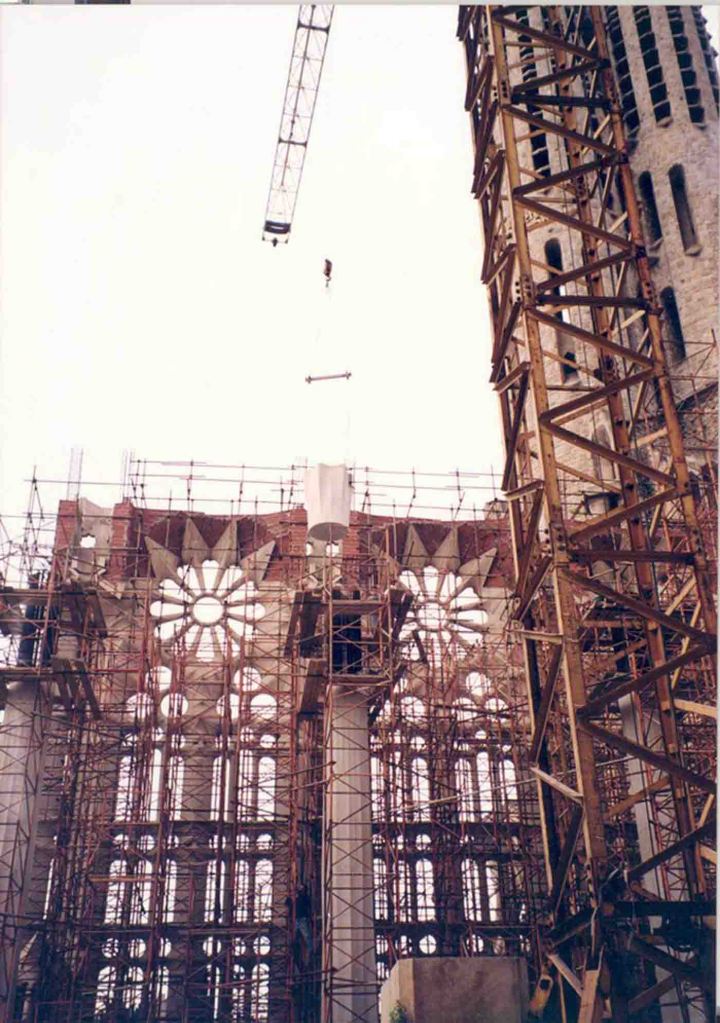
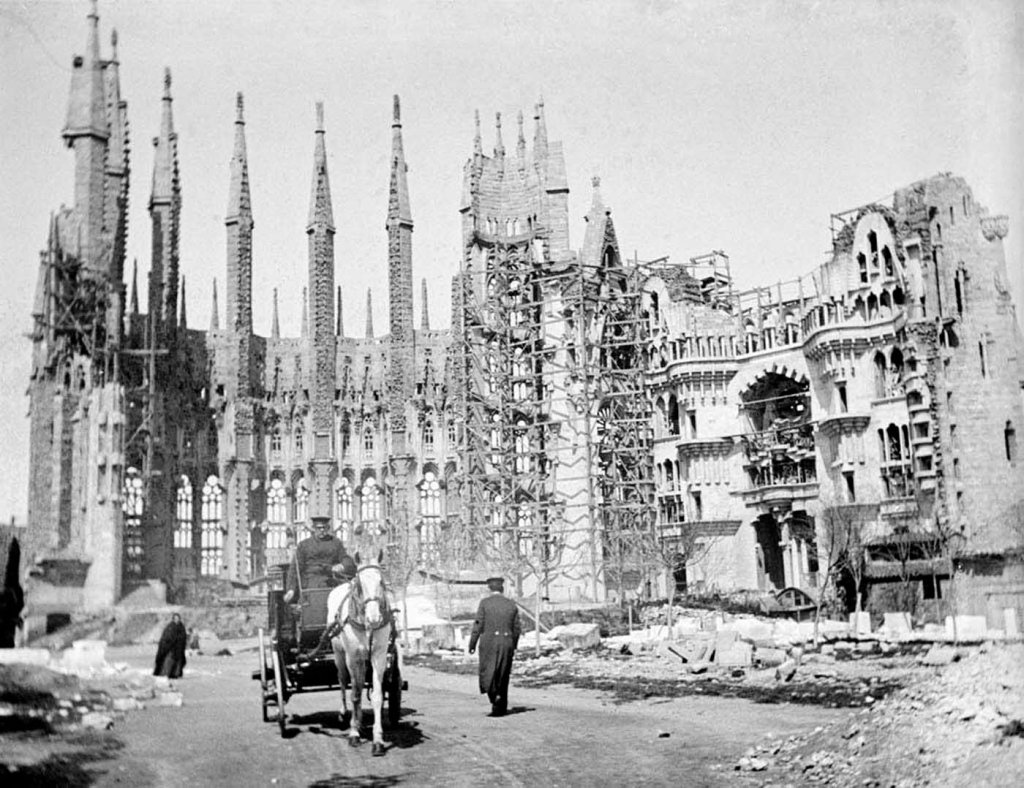
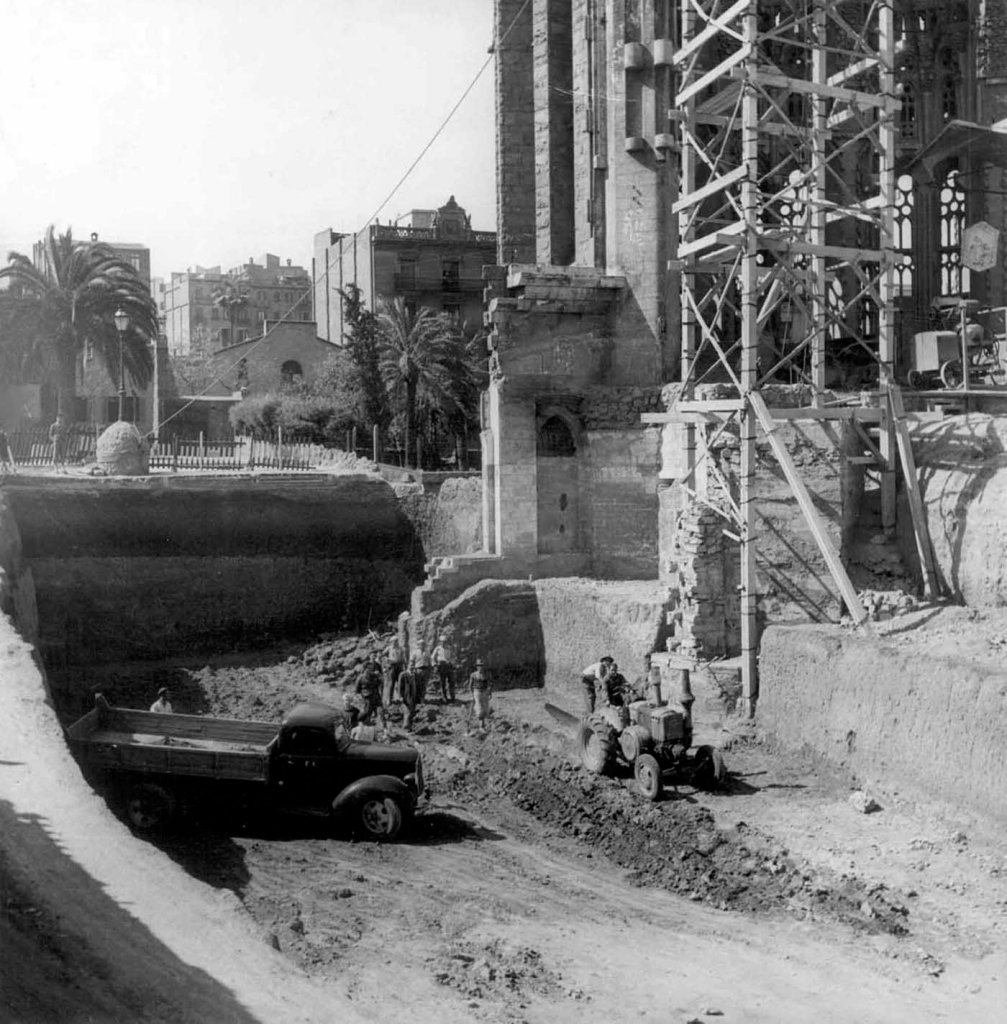
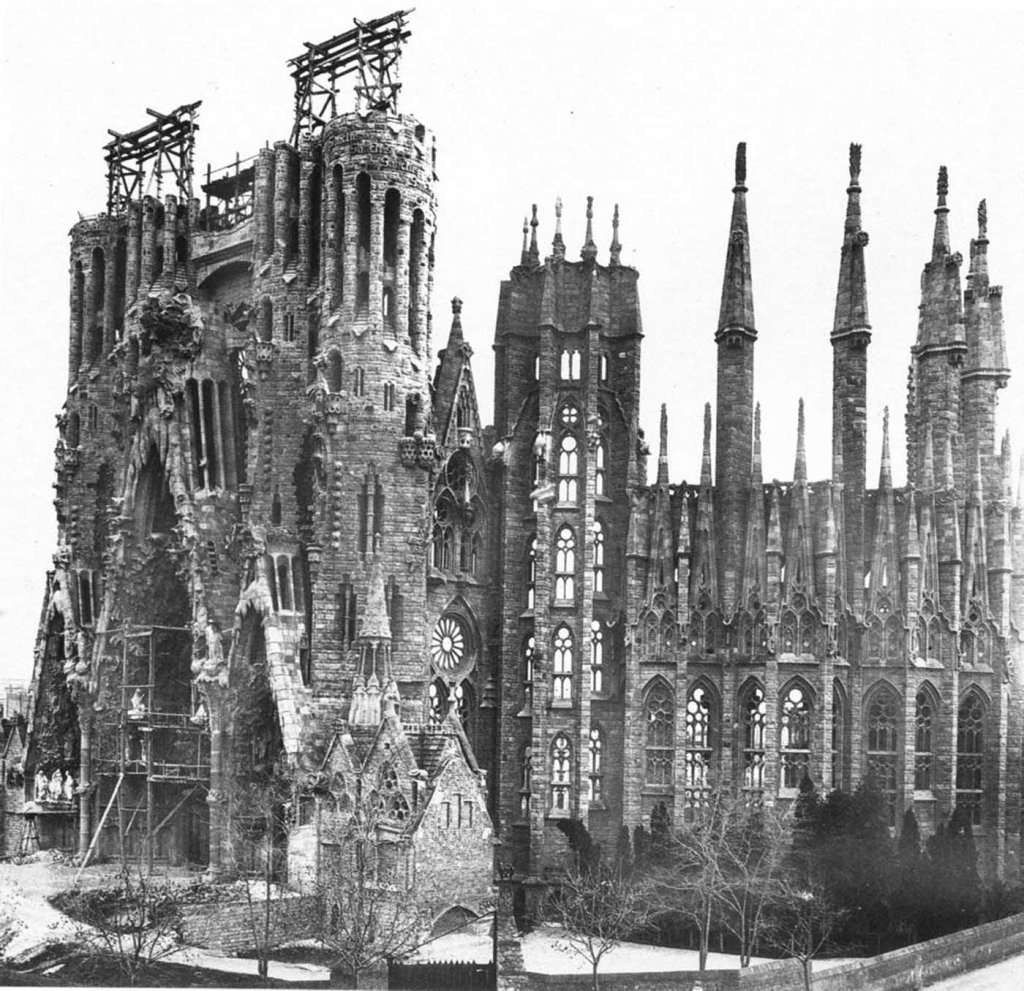
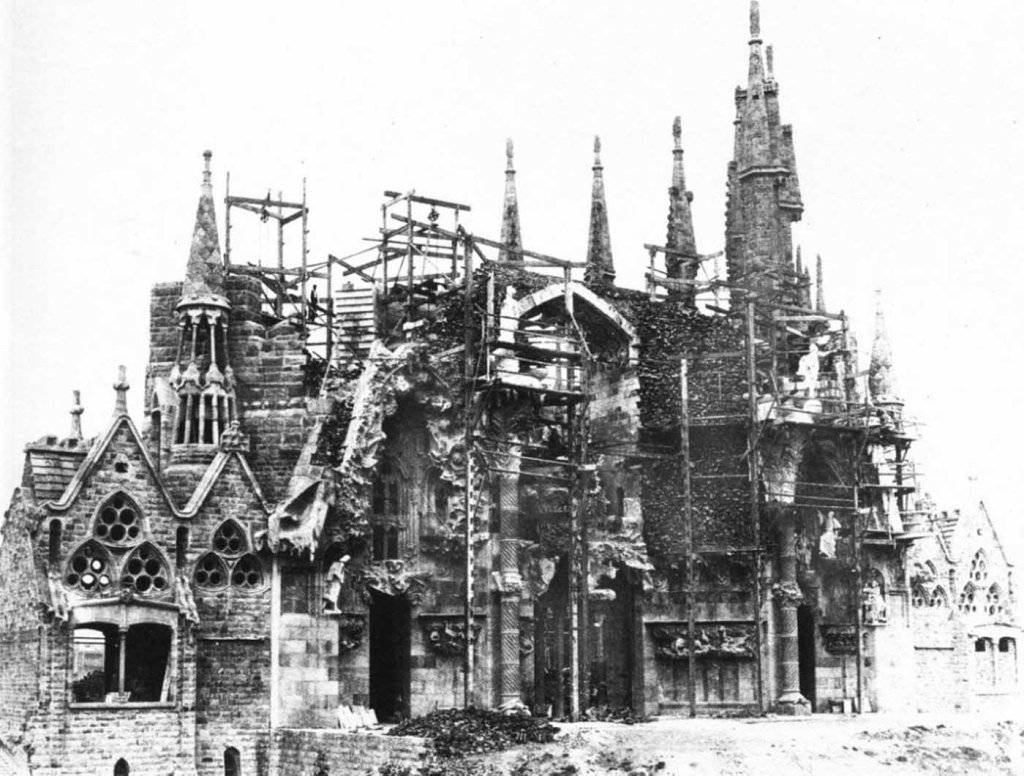
La Sagrada Familia under construction, 1887.
Eventually, Gaudí found himself in a pauper’s hospital in Barcelona, his true identity hidden from everyone until a concerned friend recognized him the following day. Despite attempts to transfer him to a more suitable facility, the great architect refused, declaring, “I belong here among the poor.” Two days later, Gaudí breathed his last breath, and he was laid to rest in the crypt beneath his unfinished masterpiece, the Sagrada Família.
rarehistoricalphotos.com
The genesis of this church traces back to Josep Maria Bocabella, the visionary founder of the spiritual Association of Devotees of Saint Joseph. In an era marked by social and religious turmoil in Spain, Bocabella sought to foster Catholic values. Antonio Gaudí, driven by this profound objective, conceived the Sagrada Família as a sanctuary dedicated to the Holy Family. His intention was to forge a spiritual connection between the common people and God. Every meticulous detail, from the carefully chosen colours to the elaborate sculptures, brimmed with profound religious symbolism.
As Gaudí delved into the conceptualization of the church, his inspiration emerged from the nearby Montserrat, a renowned pilgrimage destination perched atop a rugged peak. The church’s three grand façades—birth, death, and resurrection—embody his profound vision. Every element of the design resonates with mystical Christian symbolism, for Gaudí envisioned the Sagrada Família as the “last great sanctuary of Christendom.”
rarehistoricalphotos.com
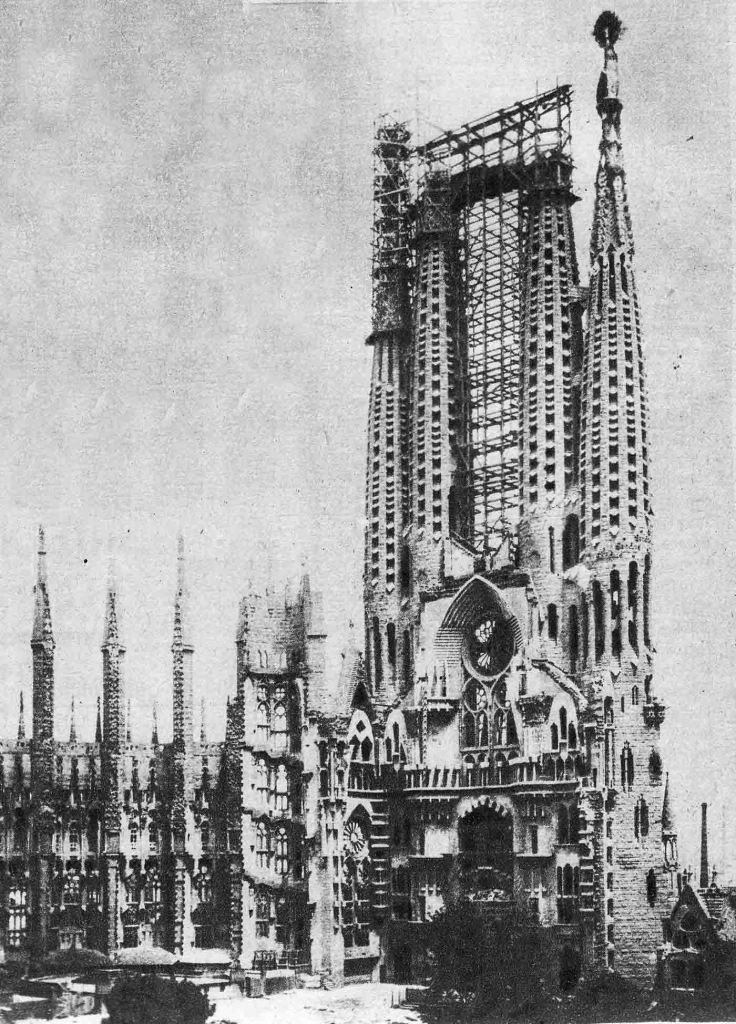
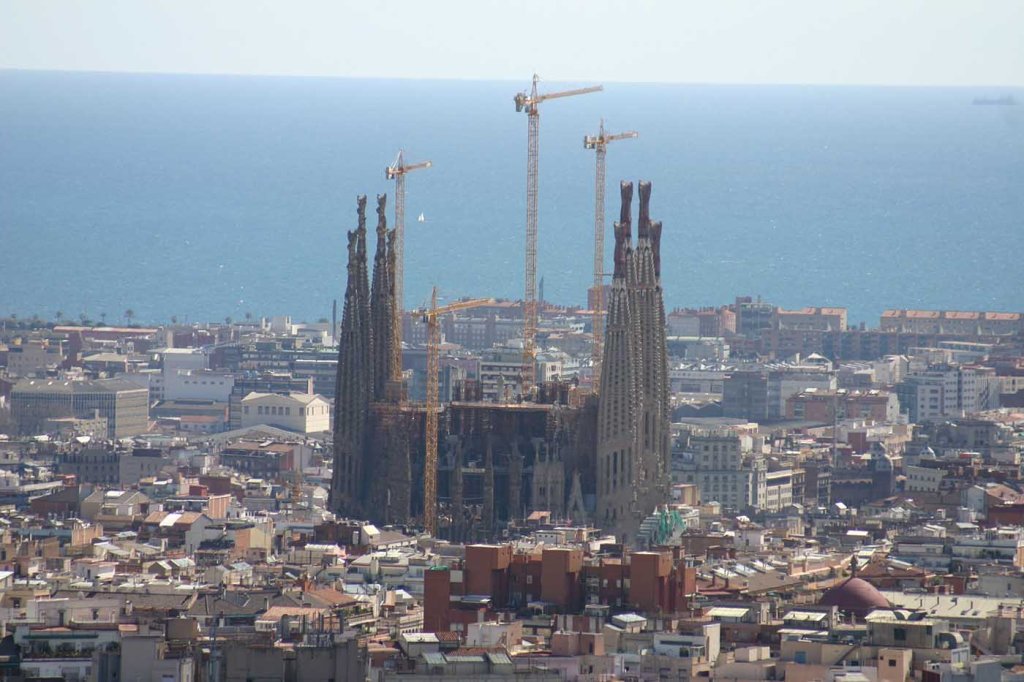
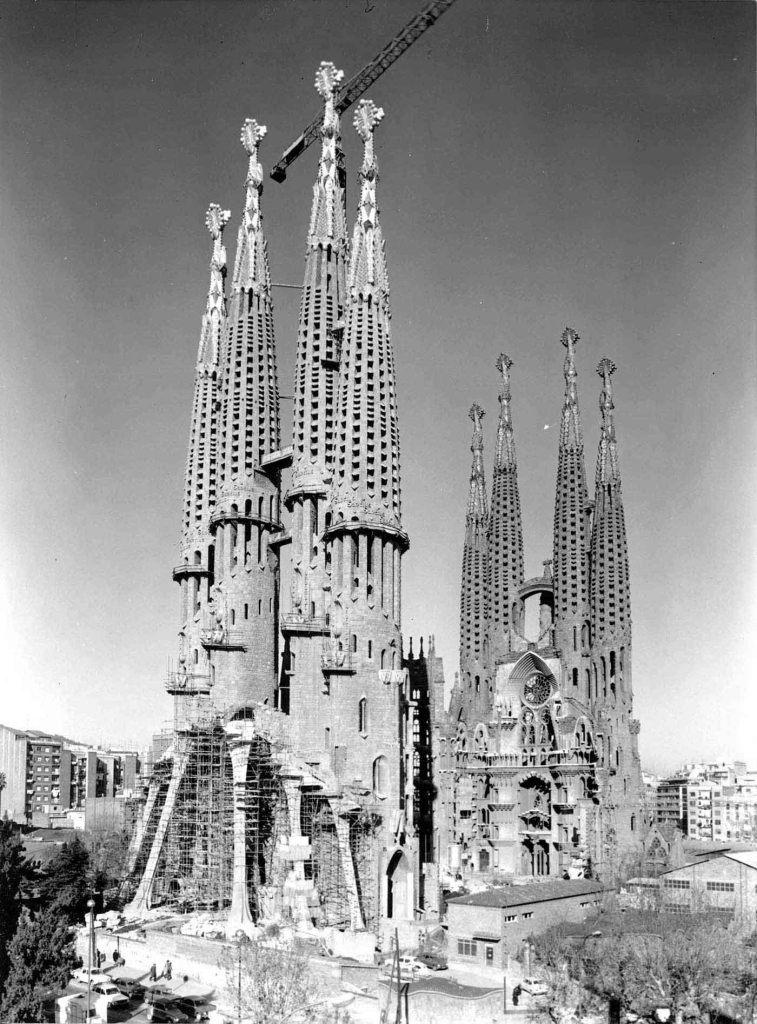
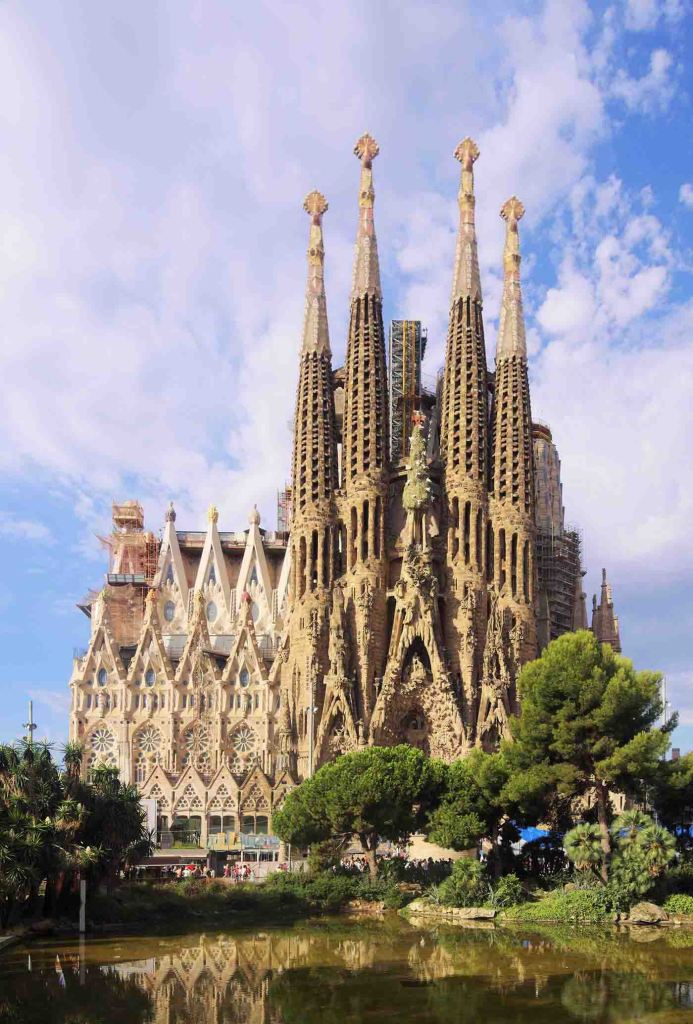
Undoubtedly, the most breathtaking feature of the Sagrada Família lies in its spindle-shaped towers. Eighteen majestic towers grace the final design, ascending in height to represent the 12 Apostles, the four Evangelists, the Virgin Mary, and, towering above all, Jesus Christ himself.
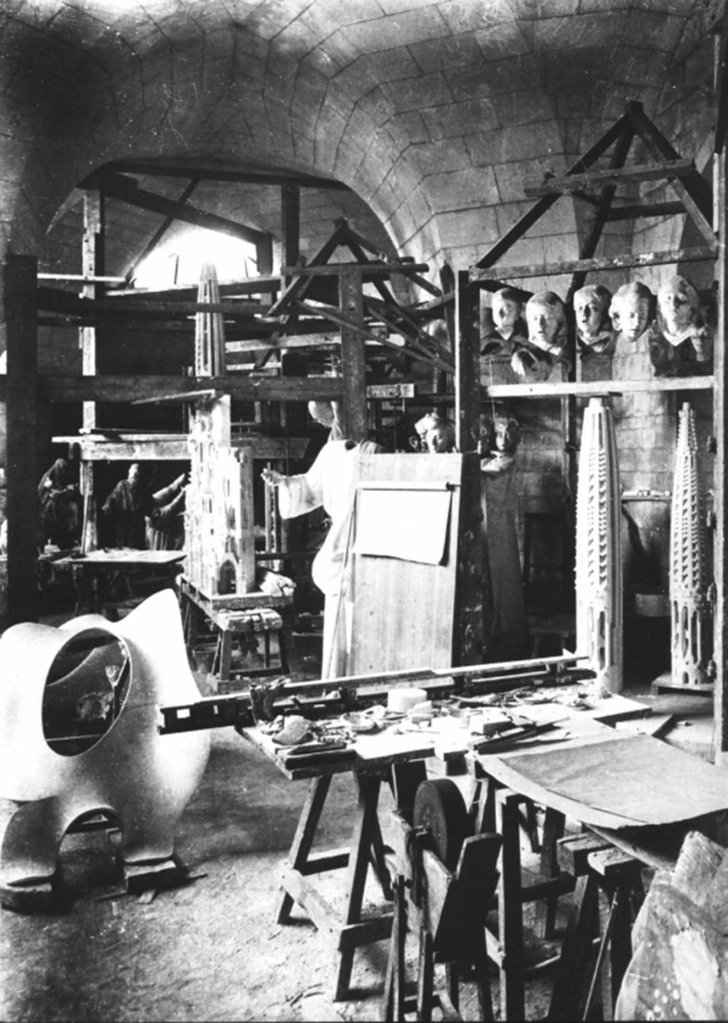
Yet, the construction of the Sagrada Família advanced slowly, hampered by the tumultuous Spanish Civil War. In July 1936, revolutionaries set fire to the crypt and breached the workshop, causing irreparable damage to Gaudí’s original plans, drawings, and plaster models. This catastrophe necessitated 16 arduous years to meticulously reconstruct the fragments of the master model.
rarehistoricalphotos.com
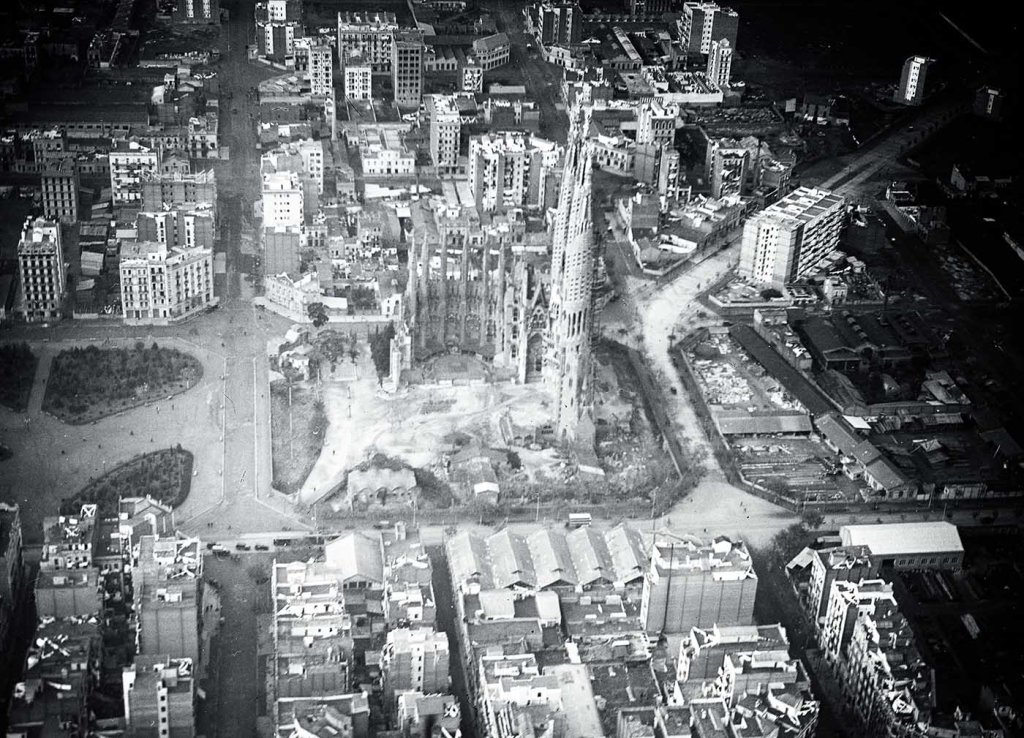
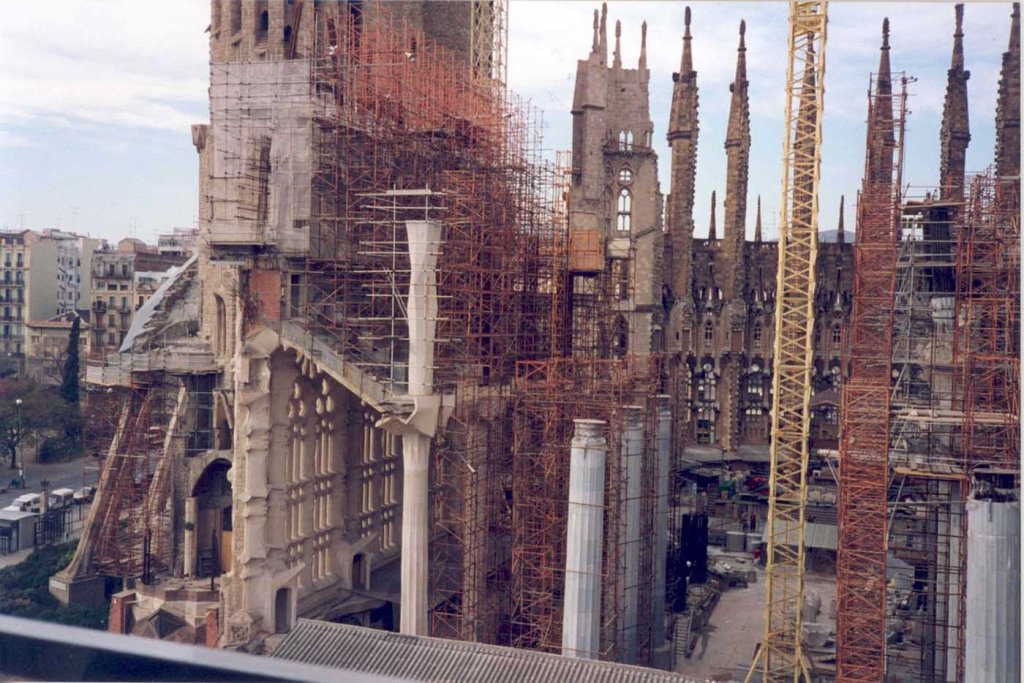
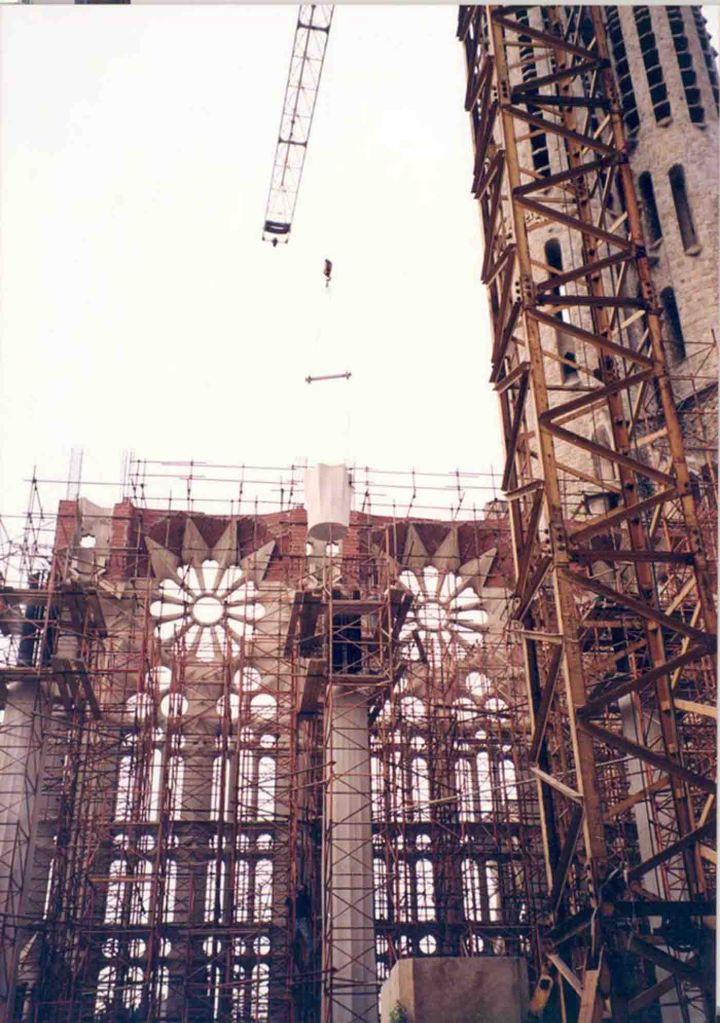
Presently, the Sagrada Família remains an ongoing endeavour, its completion a distant horizon. The vast structure relies solely on personal donations, just as the original concept demanded. It is the millions of yearly visitors who predominantly finance the continuous construction of the Sagrada Família, each contributing a small piece to this grand architectural symphony.
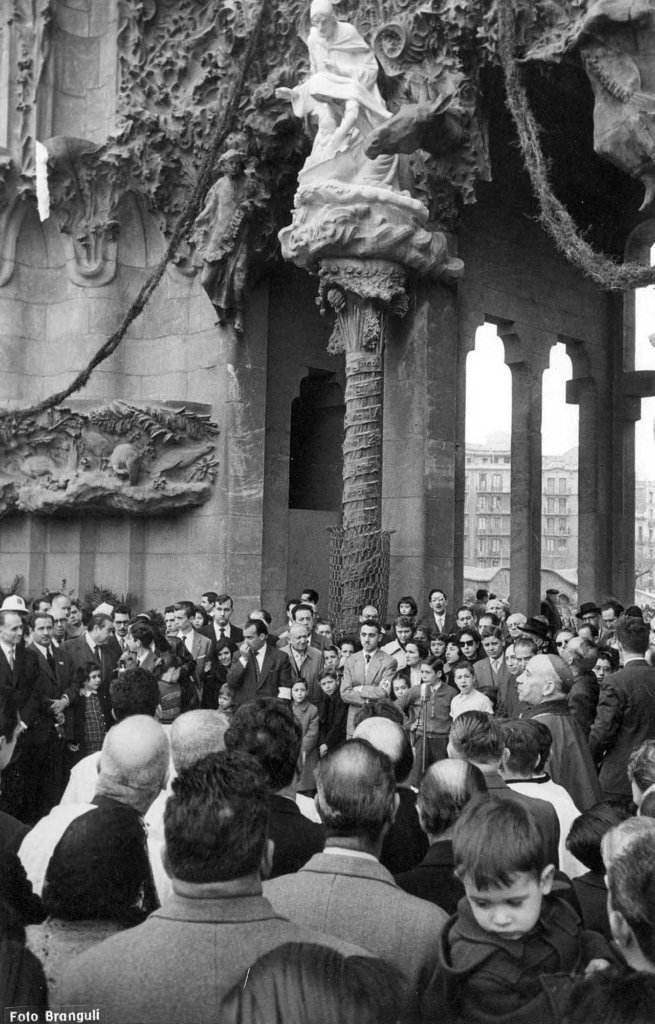
Allow me to delve into the mesmerizing design concepts behind the Sagrada Família. The church boasts three grand façades: the Nativity façade to the East, the Passion façade to the West, and the Glory façade to the South, still awaiting completion. The Nativity Façade, embodying the most direct influence of Gaudí, was erected before work was interrupted in 1935.
rarehistoricalphotos.comrarehistoricalphotos.com
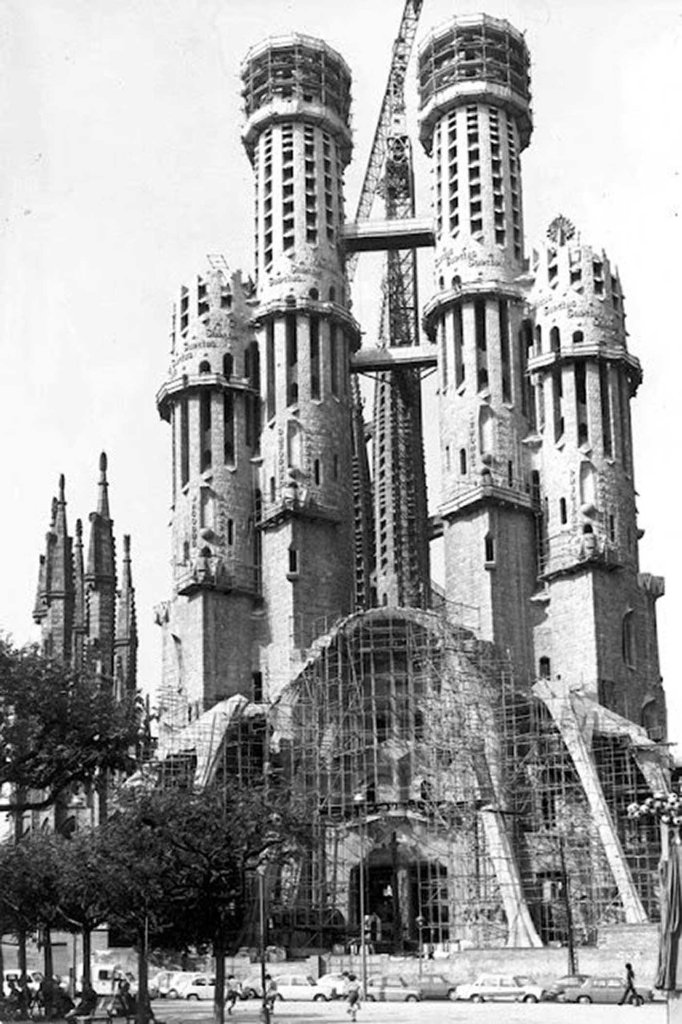
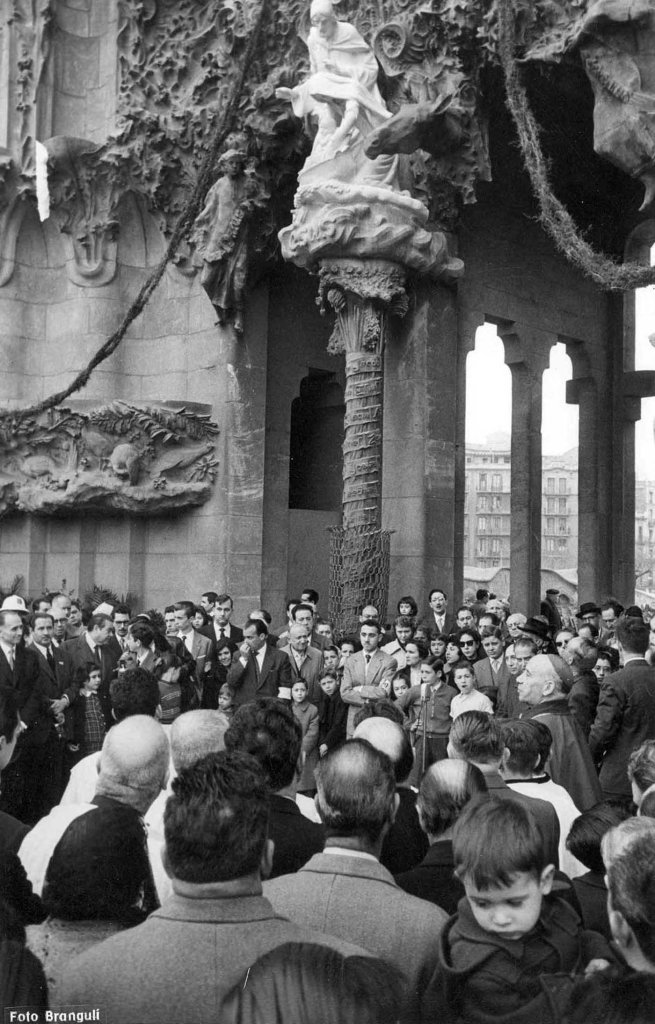
The Passion façade, constructed according to Gaudí’s 1917 design, commenced in 1954, with the stately spires adorning the elliptical plan completed in 1976. Notably, this façade captivates with its austere, anguished figures, including emaciated depictions of Christ enduring the scourging at the pillar and the crucifixion. These striking and, at times, controversial designs emerged under the artistic guidance of Josep Maria Subirachs.
The Glory façade, a project that commenced in 2002, is destined to become the largest and most monumental of the three. It will embody the ascent to God and will artfully depict scenes encompassing Hell, Purgatory, and a symbolic representation of the Seven deadly sins and the Seven heavenly virtues.
rarehistoricalphotos.com
Throughout the embellishments, fragments of liturgical words emerge as recurring themes. The towering spires bear ornate inscriptions such as “Hosanna,” “Excelsis,” and “Sanctus.” The grand doors of the Passion façade feature excerpts from the New Testament’s Passion of Jesus in multiple languages, predominantly Catalan.
The Glory façade, resplendent in its magnitude, will be adorned with verses from the Apostles’ Creed, while its primary portal will showcase the complete Lord’s Prayer in Catalan, surrounded by numerous iterations of “Give us this day our daily bread” translated into other languages.
rarehistoricalphotos.comrarehistoricalphotos.com
Symbolism imbues every facet of the Sagrada Família’s design, extending to its three entrances that embody the virtues of Faith, Hope, and Love, each dedicated to a particular phase of Christ’s life. The Nativity Façade represents his birth and features a cypress tree symbolizing the tree of life. The Glory façade represents his period of glory, and the Passion façade poignantly embodies his suffering. Additionally, the apse steeple bears the Latin text of the Hail Mary, a testament to the all-encompassing symbolism encapsulated within the Sagrada Família.
rarehistoricalphotos.comrarehistoricalphotos.com
Opinions on the building’s design have been as diverse as the architectural vision itself. Gaudí’s fellow architects generally applauded his innovative approach, with Louis Sullivan describing the Sagrada Família as the “greatest piece of creative architecture in the last twenty-five years—a stone embodiment of spirit!” Walter Gropius commended the structure, marveling at its “technical perfection.” Time magazine hailed it as “sensual, spiritual, whimsical, and exuberant.”
rarehistoricalphotos.com
Yet, amidst the acclaim, dissenting voices emerged. Author and critic George Orwell deemed it “one of the most hideous buildings in the world,” while James A. Michener found it to be “one of the strangest-looking serious buildings in the world.” British historian Gerald Brenan lamented the structure’s alleged vulgarity and pretentiousness.
Nonetheless, the Sagrada Família’s iconic silhouette has come to symbolize Barcelona itself, attracting an estimated three million visitors annually who flock to witness this architectural marvel firsthand. Standing in awe before its majestic towers and intricate details, one cannot help but be captivated by the transcendent beauty and unwavering dedication that converge within the heart of this unfinished masterpiece.
From Kozy-Korpesh to Romeo and Juliet: Exploring the Power of Love Across Continents
As a traveler, I have been fortunate enough to explore many lands and cultures, each with their own unique stories and legends. Over the course of three years, I encountered several tales of tragic love, each leaving a deep impression on me. It was only after reflecting on these stories that I realized the deeper connection they shared.
During my first year of traveling, I found myself in Istanbul for six months. There, my fascination with Ottoman history led me to discover the story of Layla and Majnun. This classic love story from Arabic and Persian literature tells of two young lovers who are deeply in love but are kept apart by their families and society. Despite the obstacles, they remain devoted to each other until death. As I wandered through the streets of Istanbul, I couldn’t help but feel the powerful emotions that this story evokes, and I was struck by the enduring nature of love, which transcends time and cultural boundaries.
After my time in Istanbul, I traveled to Egypt before making my way to Athens, Greece. There, I learned about the tragic love story of Pyramus and Thisbe, a myth from ancient Greece. The story tells of two young lovers who fall in love despite being forbidden to see each other by their families. They communicate through a crack in a wall, and when they plan to run away together, Thisbe is attacked by a lion. Thinking she is dead, Pyramus takes his own life. When Thisbe finds him dead, she also takes her own life. The symbolism of the bloodstained veil spoke to me on a profound level, reminding me of the power and tragedy of young love torn apart by forces beyond their control. Their tale of forbidden love, symbolized by the bloodstained veil, spoke to me on a profound level.
A year later, I found myself in England for the first time, and as a Canadian, I was raised with strong British and Shakespearean influences. It was in England that I truly began to appreciate the power of Shakespeare’s iconic love story, Romeo and Juliet. The story is set in Verona, Italy, where two young lovers, Romeo Montague and Juliet Capulet, fall in love despite their families’ long-standing feud. The young couple’s love is forbidden, and their families’ enmity leads to a tragic end when they both take their lives.
The story of Romeo and Juliet has been adapted and reimagined countless times in popular culture. From the classic 1968 film adaptation directed by Franco Zeffirelli, to the modernized 1996 version starring Leonardo DiCaprio and Claire Danes, the story continues to capture the imagination of audiences. The play has also inspired a range of musical works, including the 1957 Broadway musical West Side Story, and Taylor Swift’s song “Love Story” which features direct references to the story of Romeo and Juliet.
The enduring popularity of Romeo and Juliet can be attributed to its universal themes of love, passion, and tragedy, which continue to resonate with audiences of all ages and backgrounds. As a traveler and a lover of stories, I couldn’t help but be drawn to the timeless allure of this iconic tale of love and loss.
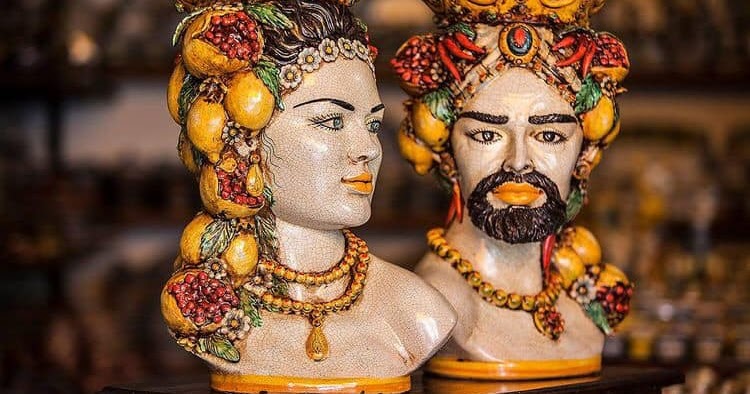
My next stop was Sicily, where I stumbled upon a market selling Sicilian moors heads. I was intrigued by the sculptures, and my curiosity led me to the tragic love story of Bianca and Cesare, two young lovers from rival families whose story inspired the creation of the moors heads. I discovered that the moors heads are a popular icon on the island, with their intricate details and vibrant colours making them stand out. They are often made into high-quality ceramic pieces, with many people displaying them in their homes or businesses. In addition to their visual appeal, the moors heads are also a symbol of the island’s cultural heritage and serve as a reminder of the passion and drama of Bianca and Cesare’s love story. As I delved deeper into their tale, I found myself drawn to the tragic ending that ultimately led to the creation of these iconic sculptures.
The final piece of the puzzle came from my friend in Toronto, who was born in Kazakhstan and shared with me the story of Kozy-Korpesh and Bayan-Sulu. Their tale of forbidden love, set against the backdrop of rival clans, was yet another example of the enduring power of love. I was fascinated by the intricate details of their love story, and how it was celebrated in Kazakhstan with a special holiday called Kozy-Korpesh and Bayan-Sulu Day. Learning about their story and the holiday only added to my growing appreciation for the power of love and the diverse ways it is celebrated around the world.
As I continued my travels, I realized that these stories of tragic love were not just about heartbreak and loss, but also about the strength and resilience of the human spirit. They spoke to the power of love to transcend social barriers and unite people from different backgrounds and cultures. They reminded me of the importance of cherishing those we love, even when faced with seemingly insurmountable obstacles.
As I reflect on my journey and the tales of love and loss that have touched my heart, I am filled with a profound appreciation for the beauty of human connection. From the fiery passion of Layla and Majnun to the tragic fate of Pyramus and Thisbe, I have been moved by the enduring power of love, and the sacrifices that those who are truly devoted will make for one another. These stories have taken me on a romantic and emotional journey that I will never forget, and have taught me to never lose hope in the face of adversity. I will always cherish the memories of my enchanted time in Istanbul, the stunning afflictions of love, and the timeless inspiration of these stories. With every new adventure and experience, I will carry with me the enduring message of these tales: that love, in all its forms, will forever be the most powerful force in the world.
“Love stories that endure: From Pyramus and Thisbe to Romeo and Juliet” by Alison Flood, published in The Guardian on February 14, 2018
“A Tale of Three Cities: Romeo and Juliet, Pyramus and Thisbe, Layla and Majnun” by Alexander Nemerov, published in Lapham’s Quarterly on June 24, 2019
“The Moor’s Head in Sicilian Art: Material Culture and the Making of Identity” by Giuseppe Miccichè, published in the journal The Art Bulletin in December 2017
“Kozy-Korpesh and Bayan-Sulu: Kazakh Epic about Love and War” by Azamat Junisbai, published on Eurasianet.org on February 14, 2019
From Tobita Shinchi in Osaka to Amsterdam’s Red Light District: A Cultural Exploration of the Architecture of Sex Work
The architecture of sex work is a complex and fascinating subject that encompasses a multitude of cultural, social, and historical factors. From the neon-lit brothels of Amsterdam’s Red Light District to the discreet massage parlours of Thailand, the design and structure of sex work spaces offer a unique lens through which to explore the intersection of pleasure, desire, and urban environments. Yet, behind the façade of these spaces lies a world of contradictions and complexities, where societal norms clash with individual desires and the built environment becomes a stage for erotic performances. In this blog, we delve into the architecture of sex work, exploring the unique design features and cultural contexts of these spaces while contemplating the deeper implications of the built environment on human sexuality.
The architecture and design of sex work spaces have a complex relationship with the social, cultural, and economic contexts in which they exist. From the traditional brothels in Japan to the modern-day streetwalkers in the US, sex work spaces have been shaped by various factors, including legal frameworks, cultural norms, and societal attitudes towards sex work.
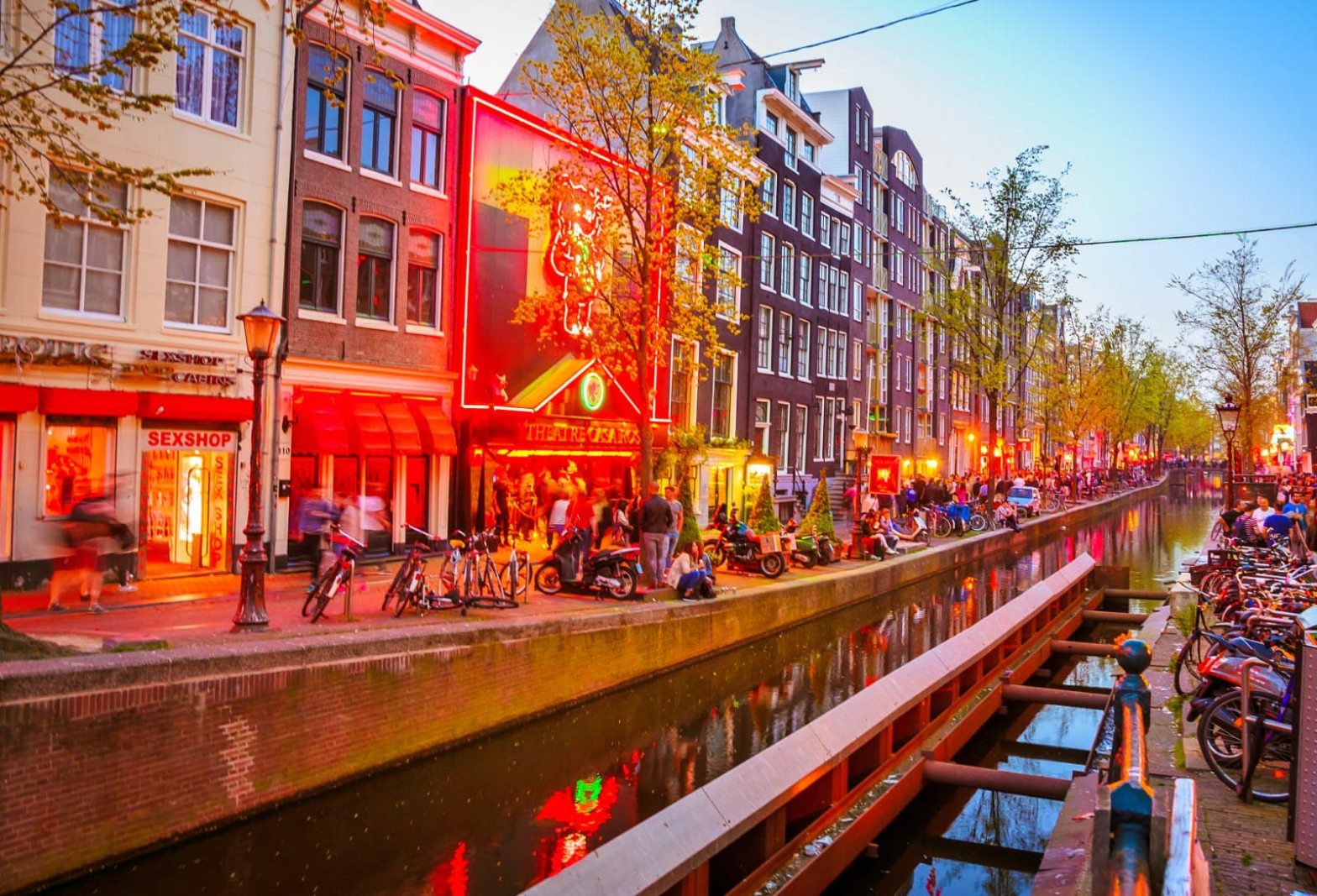
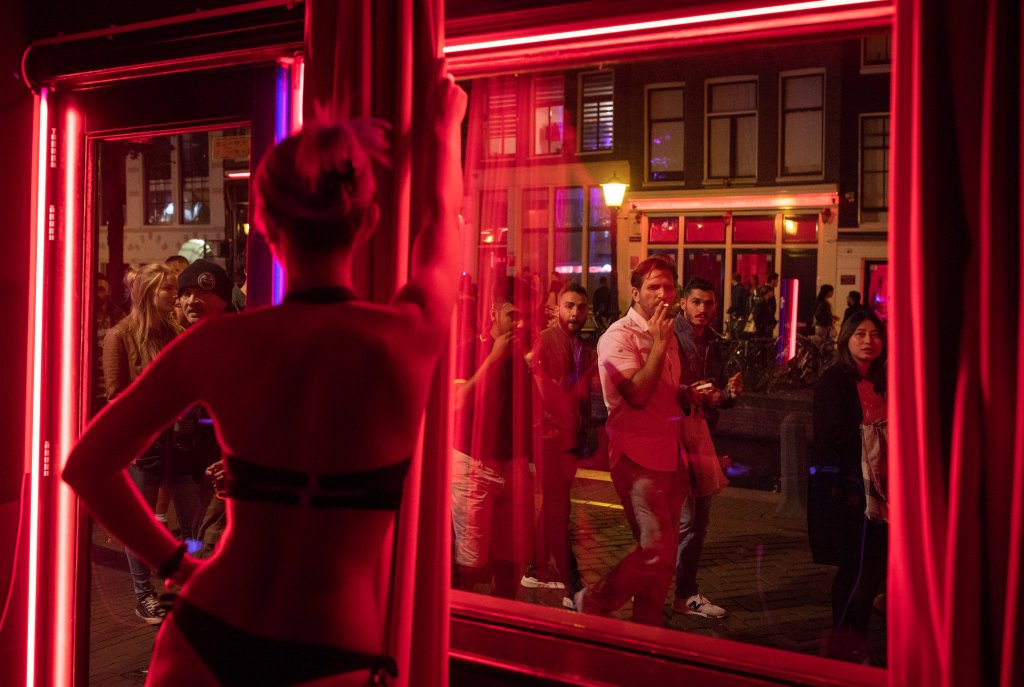
In Amsterdam’s Red Light District, the architecture and design of the brothels and window displays are regulated by the city’s government. The buildings themselves are historic and narrow, with a mix of traditional Dutch architecture and modern interventions. The red-light windows that display the sex workers have distinctive red and blue neon lights, which have become a symbol of Amsterdam’s sex industry. The city has also implemented various design interventions to improve safety and hygiene, such as security cameras, panic buttons, and separate entrances for sex workers and clients.
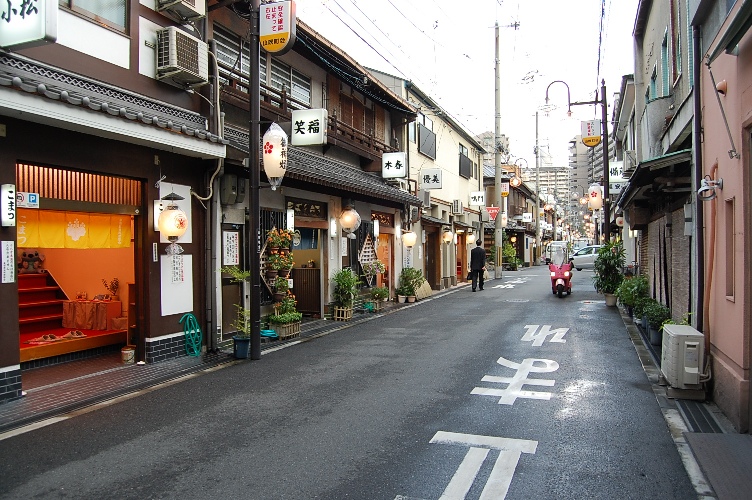
Tobita Shinchi, Japan’s largest red-light district, has a long history dating back to the Edo period. The district is comprised of narrow streets and alleys lined with brothels, bars, and restaurants. The buildings are typically wooden and have a distinctively Japanese architectural style. Each brothel has a unique façade that is often adorned with lanterns and signage, making it easy for customers to identify their preferred establishment. The design of the streets is also important, with the narrow alleys creating a sense of privacy and intimacy.
Stepping into Tobita Shinchi’s recreated traditional streets is like entering a timeless realm where history and desire intertwine. Wooden structures, weathered by time, exude an authentic aura, their graceful curves and intricate details whispering stories of bygone eras. Softly glowing lamps and lanterns cast a warm, inviting light, illuminating hidden corners and enticing passersby. Intimacy pervades the narrow, cloistered alleys, with leaning facades creating a sanctuary from the outside world. Elaborate wooden carvings, depicting love and lust, adorn the facades, while the rhythmic patterns of meticulously crafted beams showcase enduring craftsmanship. The aroma of incense mingles with whispers of secrecy, adding an alluring touch to this symphony of desire, where tradition and modernity converge, and architecture becomes an accomplice to unfolding fantasies.
In Thailand, massage parlours that offer happy endings are often disguised as legitimate businesses, with the sex work aspect hidden from plain view. The design of these spaces is typically modern and minimalist, with subdued lighting and discreet signage. Some parlours may have private rooms or curtained-off areas where the sex work takes place.
In contrast, the architecture and design of American streetwalking and hourly motels are often characterized by a lack of permanence and a focus on anonymity. Many streetwalkers operate in urban environments, using alleyways and abandoned buildings as their workspace. The hourly motels that cater to sex workers are often located in seedy neighborhoods and offer little in the way of amenities or design.
It’s worth noting that the architecture and design of sex work spaces are often influenced by legal frameworks. In countries where sex work is criminalized, the spaces tend to be more discreet and hidden, while in countries where sex work is legalized, the spaces are more visible and regulated.
Overall, the architecture and design of sex work spaces are shaped by a multitude of factors, from cultural norms to legal frameworks. While some spaces have a long history and distinct architectural styles, others are characterized by anonymity and a lack of permanence. As an urban planner, architect, and historian, it’s important to approach this topic with sensitivity and an understanding of the complex social, cultural, and economic contexts that shape these spaces.
The architecture of sex work reveals a fascinating and complex interplay between discretion and visibility, pleasure and power, desire and societal norms. From the historic streets of Tobita Shinchi to the bustling Red Light District of Amsterdam, and the hidden massage parlours of Thailand, the design and structure of these spaces reflect the cultural and social attitudes towards sexuality and prostitution. As urban planners, architects, and historians, it is our responsibility to delve deeper into the design features of these spaces, their cultural and historical contexts, and the impact they have on human sexuality and urban environments. By doing so, we can gain a greater understanding of the complex and often contradictory nature of sex work, and work towards creating more inclusive and equitable cities for all. This exploration of the architecture of sex work in contemporary society highlights the ongoing need for nuanced and thoughtful discussions on the intersection of sexuality and the built environment.
Sources:
Hubbard, P. (2011). Sex zones: Intimacy, citizenship and public space. Routledge.
Strega, S., & O’Brien, J. (2016). Mapping the terrain of sex work in an era of change. Journal of Sex Research, 53(4-5), 419-437.
Williams, L. R. (2016). Sex work, streetwalking, and gentrification in New York City. Urban Geography, 37(6), 855-874.
Wilson, G. (2008). Sex in the city: The devaluation of sex in contemporary American street culture. Social Semiotics, 18(3), 361-378.






















 NOMAD SKETCHBOOK