
Riding the Teleférico to Freddy Mamani‘s Neo-Andean Dreamscape
I woke up in La Paz with that specific kind of thrill only architectural pilgrims know. The kind that creeps in your chest when you realize: today you’ll get to see a building you’ve studied in photos for years or click through everytime Instagram’s algorithm finds you, or Arch Daily and Dezeen hits that right note. Today, the wild forms aren’t in your tabs or in dusty PDFs … they’re literally waiting outside. If you’re the kind of person who travels for structures instead of beaches, who rides cable cars just to see the city from a new perspective, then you’ll understand. I wasn’t just visiting La Paz. I was there to meet the Neo-Andean.
Somewhere outside my questionably chosen low budget hotel room and extremely thick alpaca-labelled rough polyester blanket, the red line of Mi Teleférico was already gliding through the city packed with locals on their daily routine. The high-tension cables strung across one of the world’s most vertical metropolises (we’ll talk about gondola urbanism another time), I grabbed my camera (lets be honest, my iPhone) and stepped out into the high-altitude air.
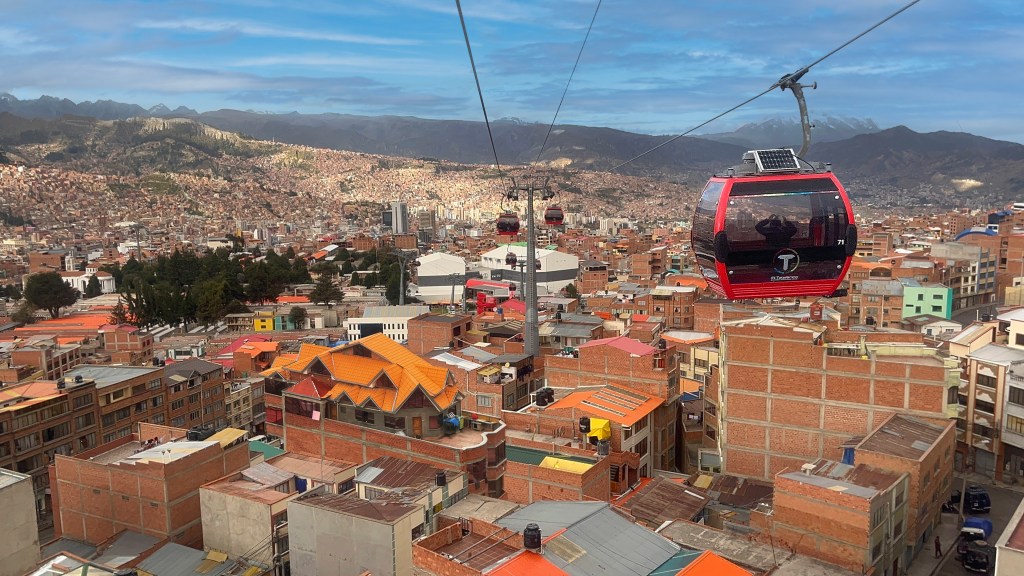


Arriving in El Alto, the shift was immediate and unmistakable. The city plateaued around La Paz below with a kind of raw density, packed with unfinished brick, tangled in cable, wide skies broken by sudden bursts of geometry. What I saw that day wasn’t just architecture—it was voltage. Cultural voltage made visible in concrete, in mud brick clad in chrome, in façades vibrating with more colour than most architects would ever risk.
To understand Neo-Andean architecture, you have to first understand what it pushes against. These are buildings born in collision: Indigenous cosmology and European colonial residue, ancestral pattern and postmodern form, memory and modernity, all jostling for space. In the early 2000s, Freddy Mamani Silvestre, a civil engineer by training, and Aymara by blood, began drawing from pre-Columbian geometry and Andean textile logic to reimagine what a Bolivian building could be. Think Ancient Temples and Alpaca Woven Rugs. The results were explosive.

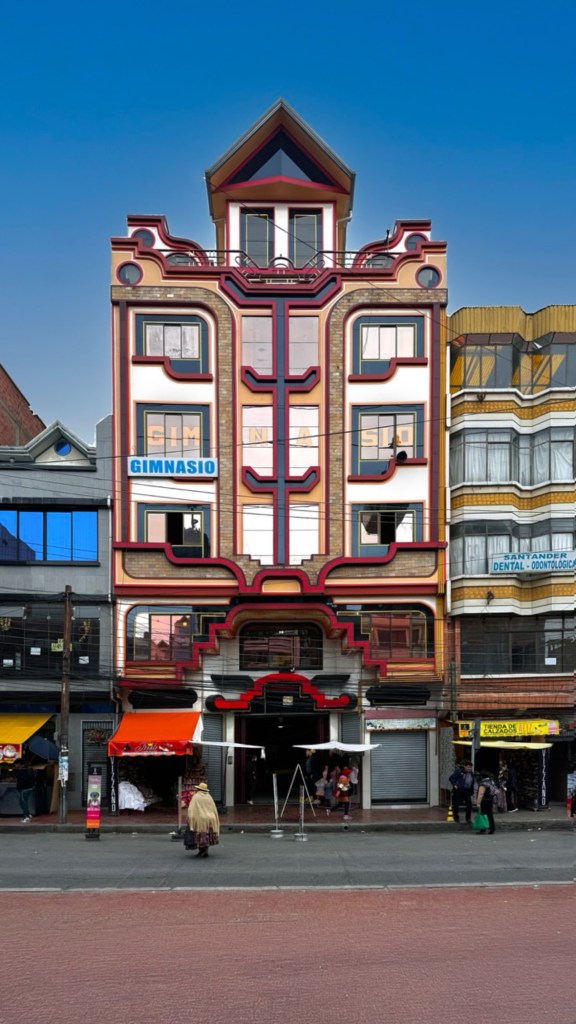
His creations are called cholets – a fusion of chalet and cholo – a name that both satirizes and celebrates their hybridity. But these aren’t jokes. They are proclamations. Where colonial cities rendered Indigenous aesthetics ornamental or invisible, think of Detroit’s Skyscrapers adorned with pan-Indigenous motifs, or Montreal’s use of First Nations figures wedged into Neoclassical pediments, Mamani’s buildings are all his own, they go loud, and are vividly unapologetic.
They are also rare. These are not everyday homes, but monuments commissioned by members of a rising Indigenous bourgeoisie, those select few who have accumulated enough wealth to build not just shelter, but statement. In a landscape shaped by historical erasure, these structures don’t merely occupy space, they reclaim it, lavishly.
I’d seen this instinct before, half a world away. In Malaysia, in the port towns of Penang and Melaka, where the Chinese merchant class of the 19th century built ornate clan houses, structures that fused Chinese, Malay, and British elements into elaborate, performative architectures of identity. Painted shutters, carved wooden screens, ceramic lions perched on tiled roofs. They too were more than houses, they were assertions: We have arrived. We belong. We are not invisible.
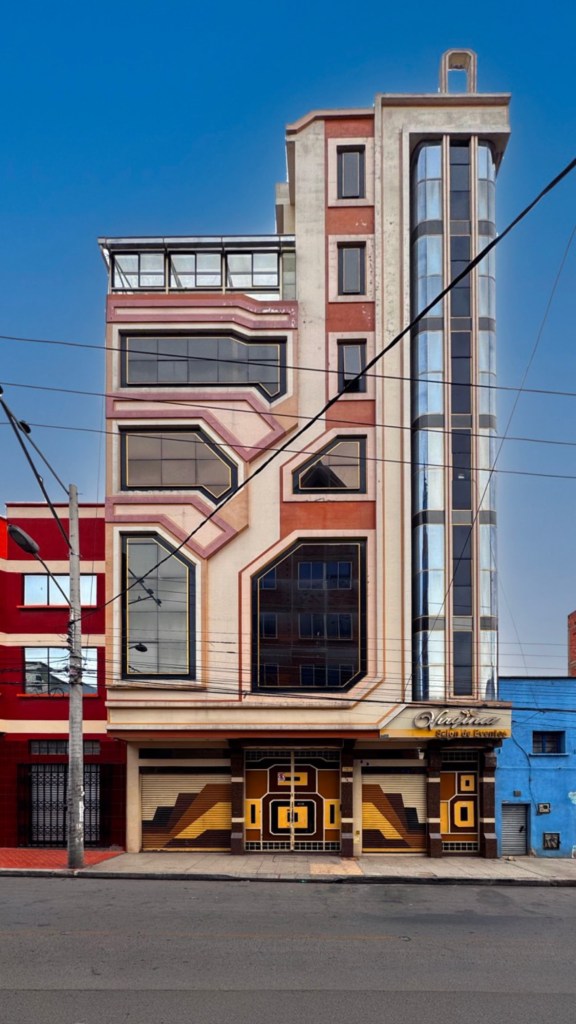

In El Alto, Mamani’s buildings do the same, but here, the material vocabulary has shifted. Instead of traditional Chinese aesthetics, there is glass in electric gradients and façades clad in chromatic aluminum, an entire vanity economy made possible by the city’s booming micro-industry of so-called aluminum carpentry, a trade whose advertisements line construction sites with unintentional comedy and real civic pride.
What emerges is a strange and mesmerizing language: Tiwanaku motifs meet Transformers aesthetics. The stepped forms of the Chakana cross sit beside window frames that look like they were ripped from the dashboard of a space truck. It shouldn’t cohere, and yet it does. Each building pulses with coded symbology, the geometry less like a façade than a woven tapestry blasted outward into space. It is part sacred diagram, part sci-fi costume. An architecture not of restraint, but of cultural layering.


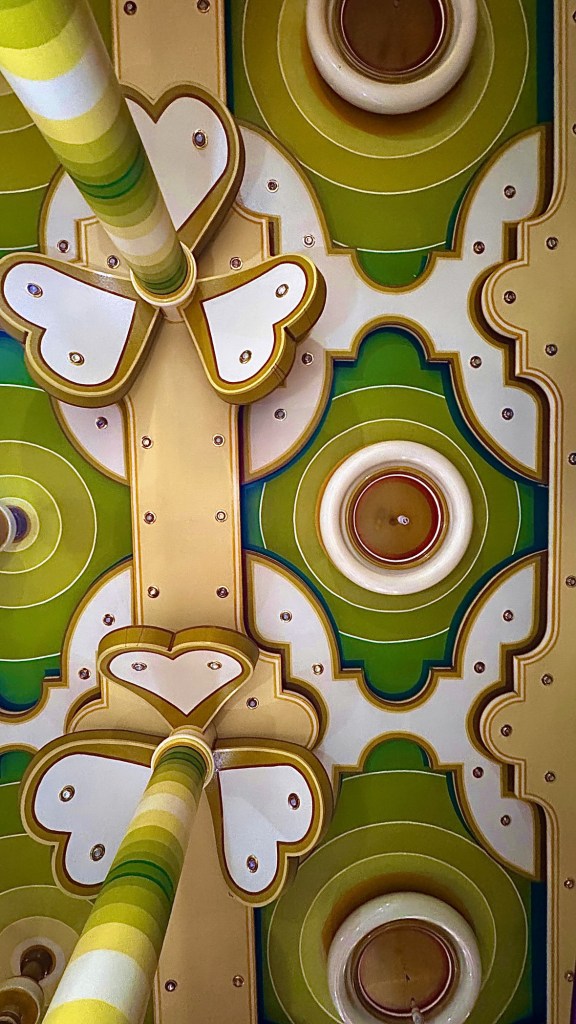
The cholets themselves follow a kind of typological triptych. The ground floor is commercial; shops, garages, businesses, the muscular base that connects the building to the economy of the street. The middle is often a salon or event space, some with mirrored ceilings, golden chandeliers, columns wrapped in spiralling light. These are the dream-spaces, where weddings and dances unfold like pageants.
And then there’s the top floor: the private family residence. This uppermost section often departs from the maximalism below. Some are starkly modern, all straight lines and austerity. Others mimic suburban domesticity, complete with pitched roofs and vinyl siding, a vision that feels strangely familiar, like the edge of a Edward Scissor Hands American suburb collaged into an Andean skyline. They seem to dream a quieter dream. Or perhaps, in that final tier, what’s being performed is not ancestral memory but aspiration, arrival into a world that once excluded them.
From the gondola, these buildings snapped into view like architectural glitches, bright interruptions in a sea of rust and brown. They don’t integrate, not at all. They rupture. They insist. It’s not harmony they’re after anyways, it’s an unapologetic presence in the urban fabric.

Western critics often miss this, dismissing the cholets as kitsch or “over the top.” But that critique flattens context. What Mamani builds is refusal. A refusal to be beige, minimal, tasteful in the narrow Eurocentric sense, where style means black-on-black wardrobes, ZARA restraint, and a single sculptural chair standing in for personality.
Step inside and that refusal intensifies: mirrored ceilings, chandeliers in a dozen hues, reflective surfaces that feel ceremonial rather than chic. These interiors don’t retreat from ornament—they exalt in it. Every material shimmers with intention, not in pursuit of luxury, but of presence. Mamani isn’t chasing the International Style. He’s rendering the internal architecture of Aymara identity in full view, after centuries of aesthetic erasure. Taste, here, is not conformity—it’s sovereignty.
Like the clan houses of the Chinese Peranakans, Mamani’s cholets are more than residences—they’re economic diagrams, social maps rendered in aluminum and glass. Their owners are members of a rising Indigenous middle and upper class: wealthy, proud, and no longer willing to tuck their heritage behind plaster or minimalist pretense. These are not homes that whisper. They shimmer. They celebrate.
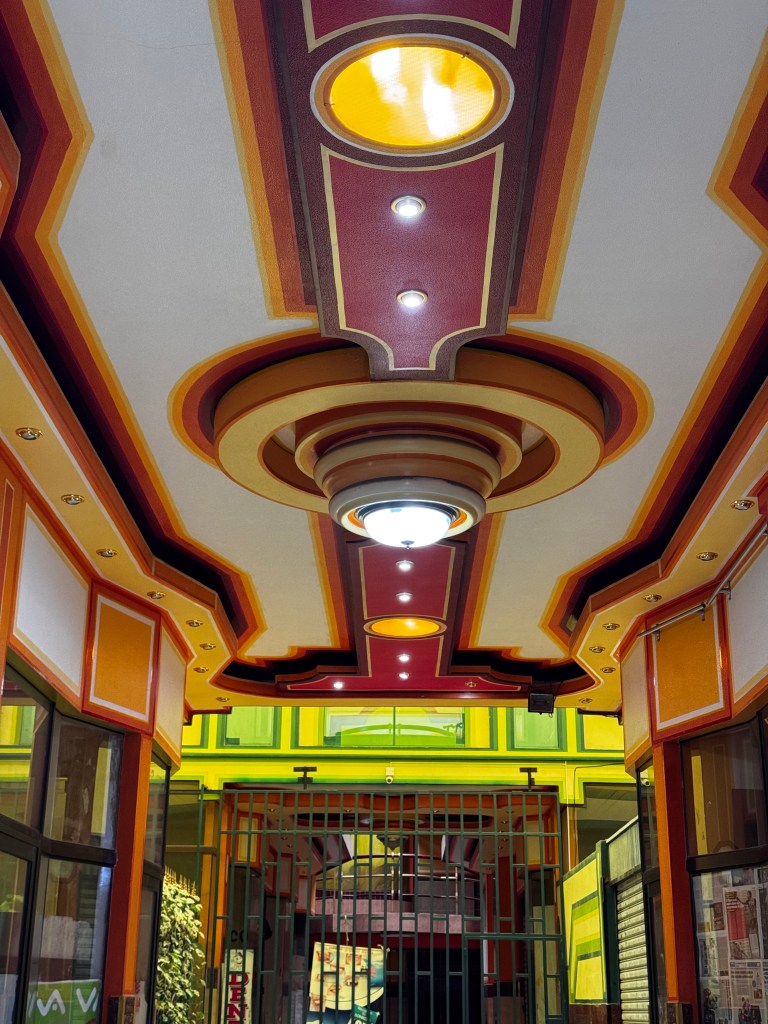


And in El Alto, that celebration takes on an even sharper edge. This is not just any city—it’s the largest Indigenous-majority city in the world, a place that barely existed in the mid-20th century and has since risen, defiantly, on the Andean plateau. Shaped by migration, marginalization, and an almost brutal topography, El Alto emerged in the 21st century as a rare thing: a city built by, for, and of Indigenous people. To build like this here, to colour the skyline with cosmology, with memory, with mirrored ceilings and Tiwanaku motifs, is not an eccentric gesture. It’s a political one.
Mamani himself said it best: “We’re returning to our own style.”
There was a moment, somewhere above the city, when I stopped trying to analyze the architecture and just let myself feel it. I put on Alt-J, and as “Tessellate” crept in, the cholets’ geometry rearranged itself in my mind—angular, seductive, off-kilter but precise. The track’s baroque-electronic layering echoed the city’s own tension: ornate yet raw, futuristic yet rooted. From there the shuffle pulled me deeper—Tame Impala’s synth-fuzzed spirals giving way to the galloping charge of Metallica, then Iron Maiden. And strangely, it all made sense. These buildings don’t whisper—they wail. They don’t align with minimalism—they solo. Walking through El Alto felt less like navigating a city and more like moving through a mixtape: maximalist, mythic, unapologetically loud.
These buildings need music. Something to match their voltage. If Mamani’s architecture has a soundtrack, it isn’t Bach or Debussy. It’s electric, heavy metal, insistently hybrid. Something you move to. Something that doesn’t apologize.
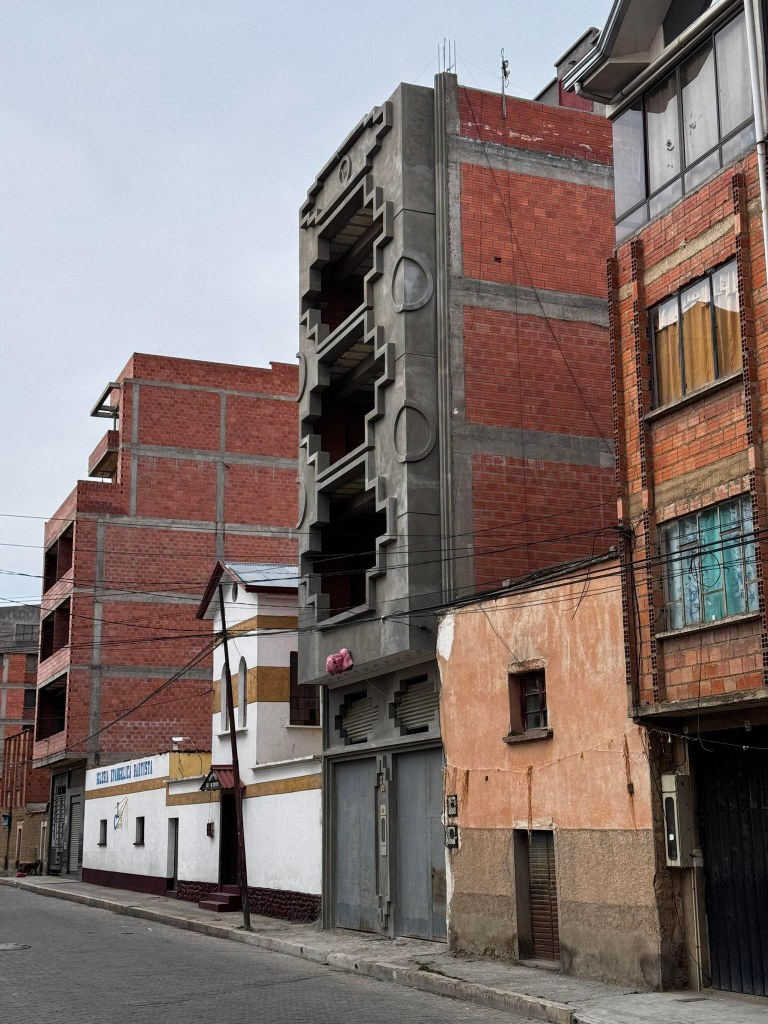

I didn’t take a map. I didn’t need one. La Paz and El Alto are cities made for getting lost in, especially from above. Riding the gondolas felt like floating across some architectural dream terrain, scanning the rooftops for signs of colour, volume, myth. I wasn’t following a route, I was following a rumour. A shape I thought I saw on the horizon. A name I barely remembered from a bootleg documentary. That’s the nourishment of this kind of wandering: the aimless, obsessive, holy kind. You don’t tour these cities, you hunt them.
By midday I was ducking into buildings I probably shouldn’t have entered, pretending to be lost, lingering in event halls just long enough to photograph a mirrored ceiling, absorbing the silence of a ballroom built for five hundred people who hadn’t arrived yet. Later I stopped dead in the middle of a road, halting traffic, just to get a shot of a façade that looked like an interstellar textile. A bus honked. A vendor laughed. A group of kids stared at me like I was trying to photograph a ghost. Maybe I was.
But I got the photo. I found the building. I completed the mission.
That’s what it felt like, honestly, not an architectural tour, but a mission. A modern exploration. Not for conquest, not even for understanding — but for my own wonder. For proof that the built environment can still surprise you, shake you, leave you giddy and confused.
If you want to go deeper, to feel the texture of these spaces beyond the photographs and my ramblings, watch Cholet: The Work of Freddy Mamani. It’s a wildly unique documentary, part character study, part visual fever dream, and it’s as honest, eccentric, and unshakably rooted as the buildings themselves.
 NOMAD SKETCHBOOK