
Exploring the Art Nouveau and Indian Influences in Heliopolis.
The Baron Empain Palace, also known as the Heliopolis Palace, is a stunning architectural landmark located in the Heliopolis neighbourhood of Cairo, Egypt. Built in the early 20th century, the palace is a unique blend of Egyptian, Indian, and Art Nouveau styles, making it a truly one of a kind structure, and a must-see destination for everyone interested in architecture.
The Heliopolis palace, which was built by Baron Edouard Empain, reflects the personality and vision of a man who transformed a desert into a thriving city in the early 20th century. This city, known as Heliopolis, blended Islamic architecture with the latest advancements in construction technology and urban planning to create a unique and dynamic model. The palace itself represents a fusion of architectural styles, which when brought together, is rooted in European tradition of World Exhibition Pavilions. The palace and the city of Heliopolis both demonstrate the ability of talented individuals to create something extraordinary out of a seemingly barren landscape, and invite visitors to experience the mood and spirit of the Belle Époque.
In the 1860s, the Egyptian ruler Khedive Ismail was inspired by the transformation of Paris into a modern city, and he sought to recreate this transformation in his own capital. He wanted to create a “Paris on the Nile,” and to a large extent, he succeeded in building a Western-style Downtown district with an opera house, hotels, banks, and department stores on newly accessible land made available by the shifting of the Nile River. By 1900, this new Cairo was a thriving, modern city, with land prices that were comparable to those in Brussels and Paris. Transport magnate Edouard Empain had the idea to purchase cheap, outlying land, connect it to Downtown Cairo, and build a new city, which became known as Heliopolis.


Located in Heliopolis, this dramatic neighbourhood is known for its eclectic history and huge cultural importance to the region, as well as its role in the development of modern infrastructure and technology in the country. Founded in the 19th century, Heliopolis was a separate city that was named after the ancient Egyptian city of Heliopolis, the centre of sun worship in ancient Egypt.
One of the key features of Heliopolis was its innovative infrastructure, which included the first airport in Egypt, the Heliopolis Aerodrome, and the first tramway in the country, the Heliopolis Tramway. These modern transportation systems played a significant role in the development of Heliopolis and helped to make it a thriving and vibrant city.

Another important aspect of Heliopolis’s infrastructure was its electrical system, which was one of the first in the country. The Heliopolis Electricity Company, founded in 1906, was responsible for bringing electricity to the city and played a key role in its growth and development.
Today, Heliopolis is a thriving and vibrant neighbourhood that is home to a diverse range of businesses, restaurants, and cultural attractions. Its rich history and innovative infrastructure make it a fascinating and destination not to be overlooked by tourists interested in the history and development of modern Egypt.
The palace was commissioned by Baron Edouard Empain, a Belgian businessman and developer who was instrumental in the creation of the Heliopolis neighbourhood. The palace was designed by French architect Alexandre Marcel, who combined elements of traditional Egyptian architecture with Art Nouveau and Indian motifs to create a distinctive and opulent building.

One of the standout features of the Baron Empain Palace is its ornate and detailed exterior, which is decorated with intricate carvings, mosaics, and other decorative elements. The entire building is covered in intricate patterns and designs with the main entrance offset from the soaring dome topped tower structure.
Baron Edouard Empain built his palace in the Hindu/Khmer style during a time when buildings often featured various architectural styles that may not have been related to their construction or function. It is possible that Empain was drawn to this style due to his interest in the exotic pavilions exhibited at the Paris International Exposition in 1900. Alternatively, the palace’s design could have been meant to symbolize the global reach of Empain’s business empire, which may have had connections in Asia.

Despite the palace’s traditional appearance, it actually contained a modern, reinforced concrete structure, which was innovative for the time. This structure was created using the “Système Hennebique,” a method developed by the François Hennebique company, which specialized in reinforced concrete. The palace also featured an electric lift and a tower with elephant figures on it. Empain’s wealth was partially generated through the use of modern technology, and this is reflected in the combination of traditional and modern elements in the construction of his palace.
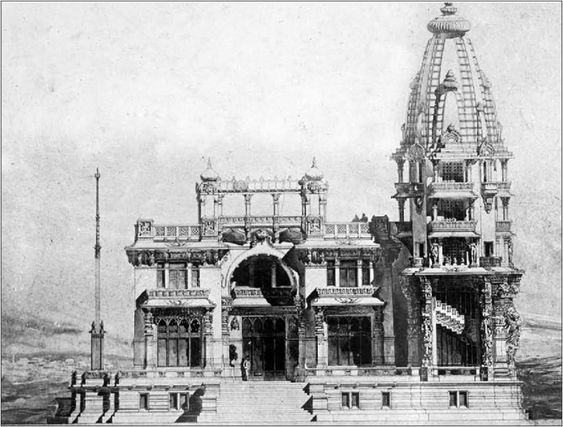
Inside, the palace is just as impressive, with lavish and ornate interiors that feature marble floors, intricate plasterwork, and ornately-carved wood and stone details. The palace’s central courtyard is a particularly striking feature, with a fountain and marble columns adorned with intricate carvings and gold leaf.
Today, the Baron Empain Palace is open to the public and serves as a museum, showcasing the history and architecture of the Heliopolis neighborhood. Visitors can explore the palace’s ornate interiors and learn more about its fascinating history and architectural significance.
Overall, the Baron Empain Palace is a must-see destination for tourists interested in architecture and history. Its unique blend of Egyptian, Indian, and Art Nouveau styles and its lavish and ornate interiors make it a truly memorable and breathtaking experience.



 NOMAD SKETCHBOOK