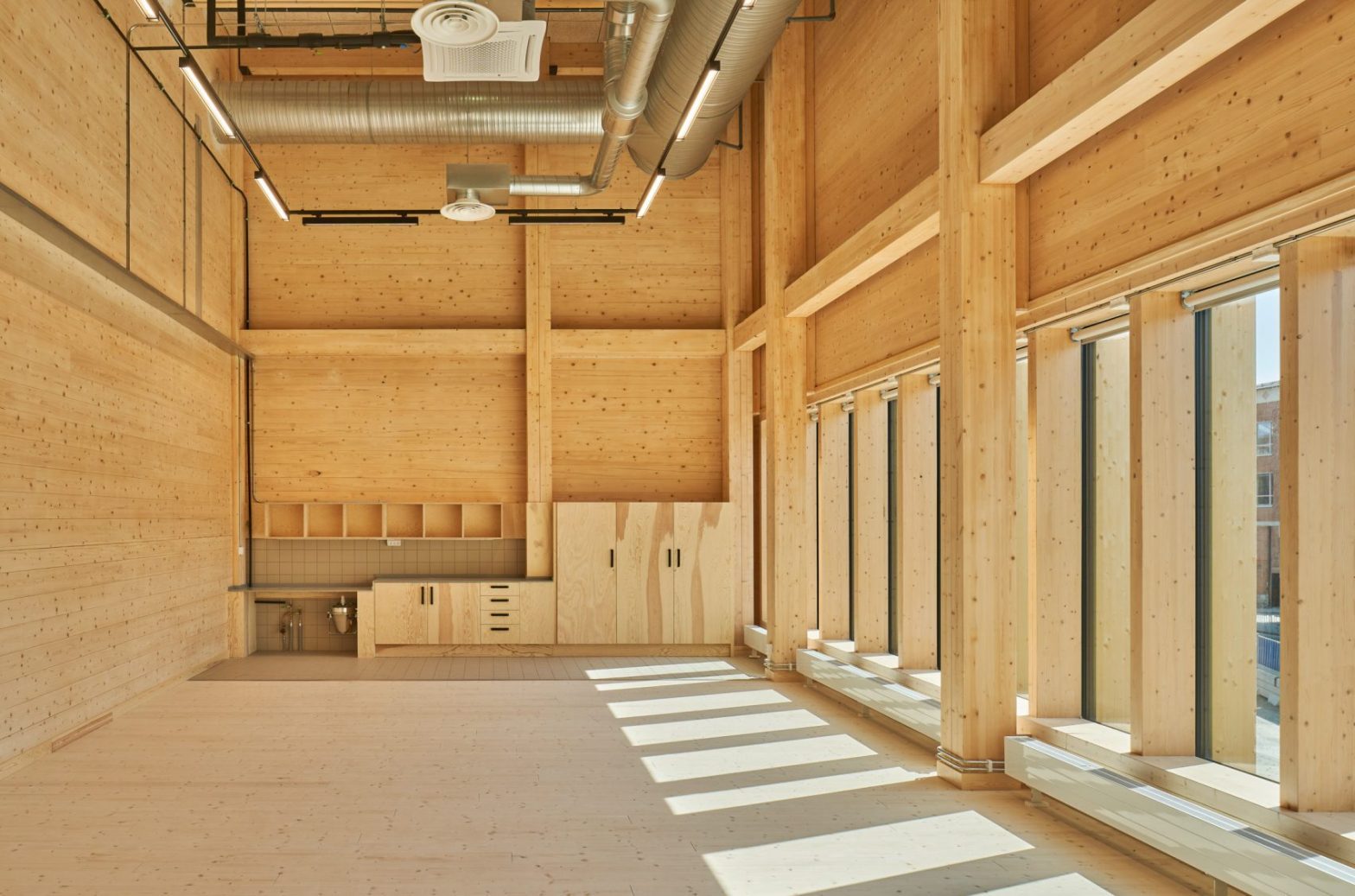
While new materials are always showing up at local building supply centres and big box suppliers, some of the most interest materials and more specialized pieces are a still special order. The advantage, though, is that they can be custom-made to size in many cases, saving labour and creating less waste. Another advantage is how these materials are evolving to better serve designers in the architecture field. Mass timber can also allow quicker, cleaner assembly on site as well as being lighter than traditional construction materials.
Developed for commercial use in Europe in the late 1980s, mass lumber materials are rapidly growing in popularity as an alternative to carbon-intensive concrete and steel that, unlike traditional timber, can be used to construct tall buildings.

Traditional dimensional lumber, two-by-four, two-by-sixes, etc., are sawn from a single log; but Engineered lumber is manufactured to exacting standards. Here’s a rundown:
CLT: Cross Laminated Timbers, also called Mass Timbers. A structural member made up of three to seven layers or more at 90 degrees to each other from strength.
GLT: Glued Laminated Timbers, also called Glulam. Wood whose grains are aligned and bonded under pressure.
PSL: Parallel Strand Lumber, also known as Parallam. Long veneer strands of wood fibres laid parallel and bonded with glue. Commonly used for long-span beams, heavily loaded columns, and beam and header applications where high bending strength is needed.
LSL: Laminated Strand Lumber is made from the shreds of fast-growing, low-value logs (aspen, birch and poplar). It’s been used mainly in smaller dimension applications such as beams, lintels, base/top plates and rim boards.
LVL: Laminated Veneer Lumber is similar to plywood except that the grain is usually only oriented in the longitudinal direction. Engineered to precise design values and with a very high strength-to-weight ratio, LVL columns, beams and lintels often replace dimension lumber or glulam as columns, beams and headers.
I-Joists: Invented in 1969, the engineered wood version of the lumber joist can carry more weight for its size. Made from laminated veneer lumber, plywood or strand board, the pieces resist bowing, twisting, splitting and shrinking and help eliminate squeaks.
Source: Canadian Wood Council
 NOMAD SKETCHBOOK