
Egyptian Art Nouveau
Have you ever come across a building with curved doorway designs or graceful floral motifs surrounding a facade of a window? If you did, then you were probably looking at Egyptian Art Nouveau.
Art Nouveau, which literally means, “New Art” in French, is a design style that emerged during the later 19th and early 20th century. Its popularity spread across Europe and North America, reaching through Mexico and to South America, and of course into the new Republic of Turkey and the occupied Egyptian territory.
Art Nouveau arose as a reaction to the 19th century dominating traditional neoclassical and academic styles, especially with the increased focus on industrialization at the time.
Artists and architects advocating this movement wanted to emphasize the importance of getting back to craftsmanship and having art incorporated back into everyday life in order to make beautiful things available.

The aesthetic was quite revolutionary and new, it came as a message of a new artistic style for the approaching 20th century.
This art movement included fine artists, illustrators, glass and jewellery designers, as well as furniture designers, for the first time, interior designers were emerging alongside architects and decorative artists.
The Art Nouveau movement began in France, and spread through Europe. In some places the style was known by different names, and slightly varied in its looks from one place to another. Terms such as Jugendstil in Germany, Stile Liberty in Italy, Sezessionstil in Austria, Modernisms in Spain, and Tiffany style in the US, are some local names of this very artistic style.
Gaudi’s famous Casa Batllo in Barcelona, and Wagners ceramic tile work on top of Majolikahaus’s main veneer in Vienna are two amazing examples of how architects shaped this style. Many other examples cn still be seen in places like Brussels in Belgium; Prague in Czech Republic, and other cities across Europe. A vivid illustration of how stunning Art Nouveau interior architecture looks like could be seen at New Amsterdam Theatre in New York City. The list, in fact, could go on and on.

But how does Art Nouveau Architecture look like?
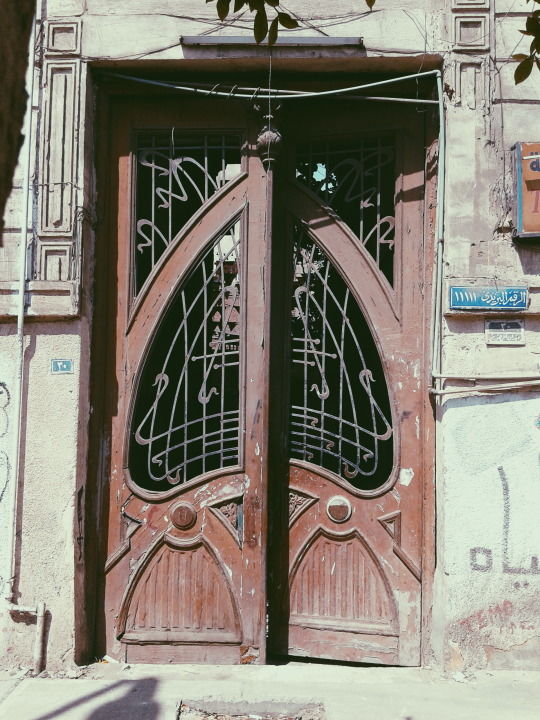
In a nutshell, the easiest way to identify an art nouveau building is by their graceful curving lines either on the facade of the structure, or even in its interiors. Some of these motifs seem almost alive like a whiplash curve; implying sophisticated curvy patterns of twisting asymmetrical lines with lots of natural forms and structures, particularly flowing lines and forms resembling the stems and blossoms of plants, leaves and flowers, as well as geometric patterns such as squares and rectangles.
Egypt, being the hub for the latest artistic trends at the that time, had its share of this beautiful architectural projects, particularly in the early 20th century. Neighbourhoods such as Al Helmeyya Al Gedeeda, Sayeda Zeinab, and Sakakini in Cairo, still have some of the best examples of Egyptian Art Nouveau structures. However its not just in Cairo, other cities, such as Tanta and Mansoura, have their share of Art Nouveau buildings.
Exploring some of the best examples of the remaining Art Nouveau projects in Egypt, graceful balconies and wooden rooms extending from lavish facades, doorways and doors.
Sakakini door,
4 buildings in Helmeya
Window in Cab Elwazeer
Building in Mansoura,
Building in Tanta
Building in Talaat Harb
Building in Sayeda Zeinab
Notably the Manial Palace style stands as the east living proof of the integration of Art Nouveauand Rococo with the many traditional architectural styles encompassing the Ottoman Moorish and Persian Designs found in Egypt.
 NOMAD SKETCHBOOK